

NCLEX Scoring and Passing Standard (2026): How NCLEX Scores Work
Ask a room full of nursing students how the NCLEX is scored, and you’ll hear a mix of half-right answers: something about a percentage, something about question count, something about “getting easy questions means you’re failing.” Almost none of it reflects how NCLEX scoring actually works. The exam runs on a statistical model most candidates never see explained clearly, and that gap is exactly where most of the anxiety around test day comes from.
This guide breaks down the mechanics behind NCLEX scoring in plain terms — what the passing standard actually is, how the exam estimates your ability as you test, and why counting questions or judging difficulty tells you almost nothing reliable about your result. If you’re earlier in your preparation, our NCLEX Preparation for Nurses guide is the better starting point; this article assumes you’re ready for the technical detail behind the scenes.
What Does NCLEX Scoring Actually Mean?

NCLEX scoring doesn’t produce a number you’ll ever see. There’s no scaled score, no raw point total, and no percentage printed anywhere on your result. What you receive is a binary outcome — pass or fail — generated by comparing a statistical estimate of your ability against a fixed benchmark.
That estimate, and the benchmark it’s measured against, are the two pieces most candidates have never had explained in detail. Understanding them changes how you interpret everything that happens during the exam itself.
Is the NCLEX Based on a Percentage Score?
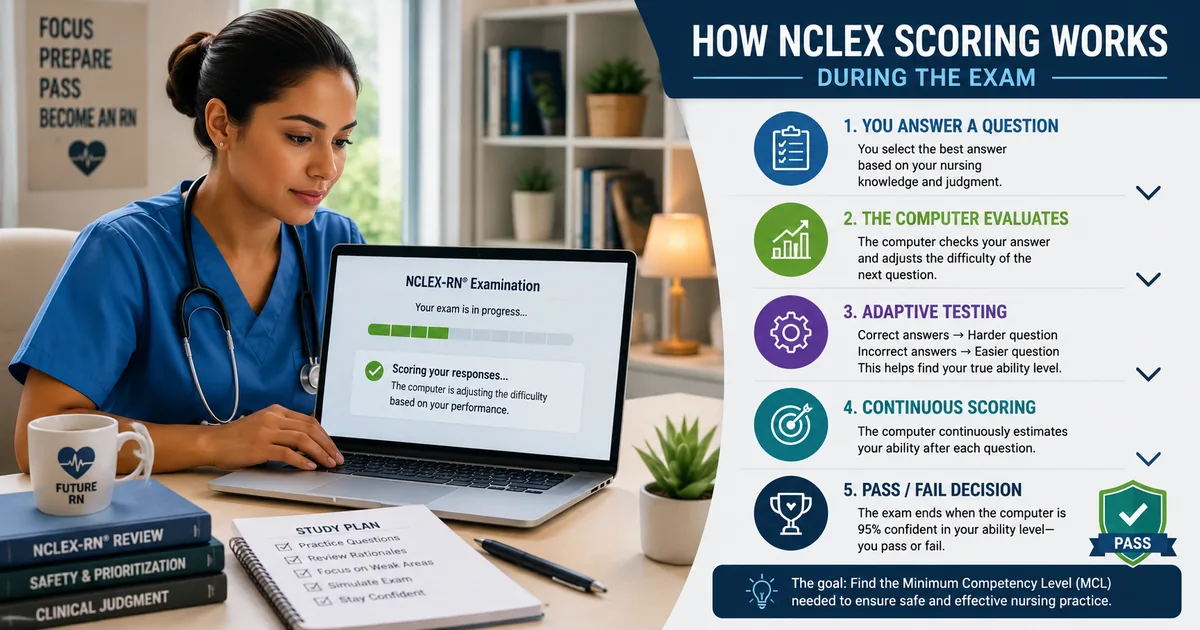
No, and this is worth stating plainly because the misconception is so common. The NCLEX does not use a percent-correct threshold of 50%, 60%, 75%, or any other fixed number. According to NCSBN, the exam is scored using a statistical framework built on Item Response Theory, not a raw count of correct answers.
This distinction matters practically. A candidate who answers a higher percentage of easier questions correctly isn’t automatically in a stronger position than one who struggles through consistently harder items, because the two performances aren’t measured on the same scale.
What Is the NCLEX Passing Standard?

The passing standard is the specific benchmark your ability estimate needs to consistently exceed. Per NCSBN’s official passing standard information, the NCSBN Board of Directors voted to uphold a passing standard of 0.00 logits for the NCLEX-RN, effective through March 31, 2029.
A logit is a unit of measurement that expresses the relationship between a candidate’s estimated ability and the difficulty of the exam items, grounded in the Rasch measurement model. It isn’t a percentage and it isn’t a count. It’s a position on a shared ability-and-difficulty scale that every candidate and every exam item is measured against.
How Computerized Adaptive Testing (CAT) Affects Scoring
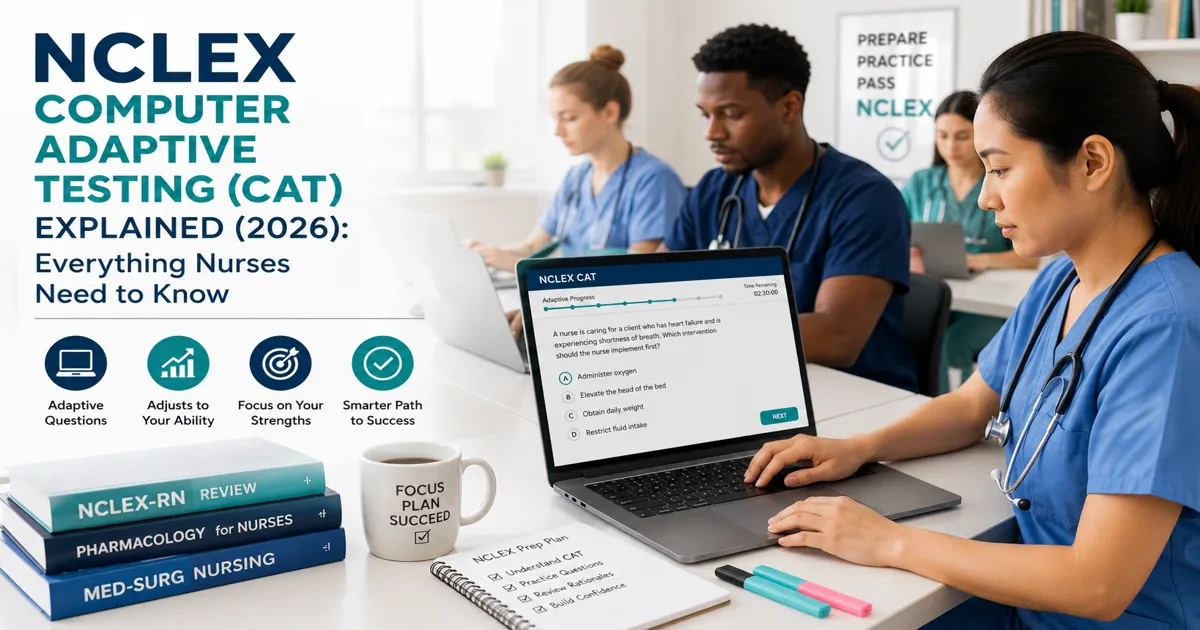
The NCLEX is delivered through Computerized Adaptive Testing, a method described in the current NCLEX-RN Test Plan as using computer technology and measurement theory to build each candidate’s exam interactively as it proceeds. Because of this, no two candidates take an identical exam — the specific items you see are selected based on your performance so far, drawn from a large item pool classified by content area, difficulty, and clinical judgment step.
This adaptive structure is the reason a simple percentage score wouldn’t make sense here. Comparing “percent correct” across two candidates who answered entirely different sets of questions, at different difficulty levels, wouldn’t produce a meaningful comparison.
How the Computer Estimates a Candidate’s Ability
According to the current NCLEX-RN Test Plan, after you answer each item, the computer calculates an ability estimate based on all of your previous answers, and the next item is selected based on that updated estimate. This happens continuously, question by question, throughout the exam.
Each item you answer serves two purposes at once: it provides the algorithm with additional information about your ability, and it narrows the statistical confidence interval around where your true ability level sits. Early in the exam, that confidence interval is wide, since the system has very little information about you yet. As you answer more items, it narrows.
Why Questions Become Easier or Harder
The exam’s item-selection logic works to keep questions targeted near your current ability estimate. Answer a question correctly, and the next item tends to be somewhat more difficult, since the system is testing whether your ability estimate should shift upward. Answer incorrectly, and the next item tends to ease off.
This means question difficulty during your exam reflects where the algorithm currently estimates your ability to be relative to the questions available in the item pool — not a scoreboard you can read in real time. Feeling like the questions are getting harder isn’t necessarily bad news, and feeling like they’re getting easier isn’t necessarily good news.
The 95% Confidence Rule
The primary mechanism that ends the exam is what’s commonly referred to as the 95% confidence rule. Once the system is statistically confident — at a 95% confidence level — that your ability estimate is either clearly above or clearly below the passing standard, the exam stops and your result is determined.
This is why exam length varies so much between candidates. Some candidates reach that confidence threshold relatively early; others need many more items before the system can make a statistically confident determination either way.
What Happens When the Exam Reaches Maximum Length?
The NCLEX-RN allows a maximum of 150 items. If the 95% confidence threshold hasn’t been reached by that point, the exam ends anyway, and your final ability estimate at that moment determines your result. This is sometimes called the maximum-length rule.
Reaching the maximum doesn’t mean the system failed to reach a decision about you — it means your ability estimate stayed close enough to the passing standard throughout the exam that more items were needed before a confident statistical determination could be made either way.
What Happens If a Candidate Runs Out of Time?

The NCLEX-RN allows up to five hours total, including any breaks. If you haven’t answered the required minimum number of questions when time expires, current NCLEX policy is that you fail automatically, regardless of how well you were performing up to that point. If you have met the minimum question requirement when time runs out, your existing responses are evaluated to determine your result.
Why the Number of Questions Doesn’t Determine Whether You Passed
This is one of the most persistent misunderstandings about NCLEX scoring, and it’s worth stating directly: the number of questions you receive is not, by itself, an indicator of your result.
Because the exam can end through the 95% confidence rule at many different points, candidates pass and fail across the entire range from the minimum to the maximum number of items. Question count reflects how long it took the algorithm to reach statistical confidence about your ability — not which direction that confidence pointed.
Does Finishing at the Minimum Number of Questions Mean You Passed?

No. The NCLEX-RN has a minimum of 85 required items. Reaching that minimum and having the exam end there means the system became 95% confident in a result quickly — but that result could be a pass or a fail. There’s no way to know which from the question count alone.
Does Reaching the Maximum Number of Questions Mean You Failed?
No, for the same underlying reason. Reaching 150 items simply means your ability estimate remained close enough to the passing standard that the system needed the full range of available items to reach a confident determination. Plenty of candidates who test to the maximum length pass.
[IMAGE 3 – a nurse reviewing NCLEX results or a study plan] IMAGE TITLE: Preparing With an Understanding of NCLEX Scoring ALT TEXT: Nursing candidate reviewing a study plan informed by NCLEX scoring rules
How Partial-Credit Scoring Works for Applicable Item Types
Not every NCLEX item is scored strictly right or wrong. Since the rollout of the Next Generation NCLEX, certain item types — including extended multiple response and some matrix or bow-tie formats — use polytomous scoring, which can award partial credit based on how many parts of a multi-part response were answered correctly.
This is directly relevant to the Next Generation NCLEX item formats and to how clinical judgment is measured throughout the exam. It’s also part of why the exam doesn’t lend itself to a simple percentage interpretation — different items can contribute to your ability estimate in different ways depending on their format and scoring rule.
How NCLEX-RN and NCLEX-PN Scoring Differ
The NCLEX-RN and NCLEX-PN share the same underlying scoring approach — Computerized Adaptive Testing, ability estimation through Item Response Theory, and the 95% confidence rule — but they use different passing standards on the same logit scale. According to NCSBN, the NCLEX-RN passing standard is 0.00 logits, while the NCLEX-PN passing standard is -0.18 logits.
Both standards are reviewed by NCSBN’s Board of Directors on a recurring cycle, using practice-analysis research and expert panels, and both are currently upheld through March 31, 2029 under the current test plan.
Common NCLEX Scoring Myths
A handful of ideas about NCLEX scoring persist despite not holding up against how the exam actually works. The belief that you need a specific percentage correct, like 75%, to pass is inaccurate — there is no percentage threshold. The idea that getting difficult questions is a bad sign, or that getting easier questions means you’re doing well, misreads what item-selection difficulty actually reflects. And the assumption that you can calculate your own result by counting questions or tracking how hard the exam felt isn’t supported by how the scoring model works, since none of that information is visible to you during testing.
How to Use This Information During Preparation
Understanding NCLEX scoring won’t change your content knowledge, but it can change how you handle the exam mentally. Instead of trying to interpret difficulty or question count in real time, you can focus entirely on answering each question as accurately as possible and let the algorithm do its job in the background.
This also reinforces why consistent performance across NCLEX practice questions, rather than chasing a specific score on any single practice set, is a more useful way to gauge your readiness. If you’re building toward a specific exam date, a structured 30-Day NCLEX Study Plan can help you stay consistent rather than reactive.
Practical Preparation Advice
Focus your preparation on genuine understanding rather than trying to game the scoring system, since there’s no reliable trick for interpreting difficulty or question count during the exam itself. Review rationales thoroughly, since the reasoning behind an answer matters more to your ability estimate over time than any single question in isolation. And if your first attempt didn’t go the way you hoped, our NCLEX Results and NCLEX Retake guides walk through what to do next, including how to use your Candidate Performance Report to prepare differently.
Reviewing NCLEX Test Day Tips ahead of your appointment also helps remove some of the uncertainty around logistics, so you can focus your energy on the exam content itself rather than the mechanics of the day.
Final Takeaways on NCLEX Scoring
The NCLEX doesn’t work like a conventional percentage-based exam, and trying to interpret your performance in those terms during the test will only add unnecessary pressure. Your result comes down to whether a statistical estimate of your ability, built continuously through Computerized Adaptive Testing, stays above or below a fixed passing standard with 95% confidence. Question count, difficulty, and how the exam “felt” don’t reliably tell you which side of that line you landed on.
Ready to Prepare With a Clearer Understanding of NCLEX Scoring?

Now that you understand how the scoring model actually works, you can stop guessing based on question count or difficulty and focus on what actually matters — consistent, well-reviewed preparation. Explore our complete NCLEX Preparation resources, strengthen your reasoning with NCLEX Practice Questions, or get personalized support through NCLEX Coaching.
Start Your NCLEX Preparation