NCLEX Test Day Tips: What to Do Before, During, and After the Exam
You’ve done the content review, worked through hundreds of practice questions, and built your clinical judgment skills. Test day itself still tends to catch candidates off guard, not because the exam content is unfamiliar, but because the logistics and pacing of the day are. These NCLEX test day tips cover exactly what to expect from the night before your appointment through the moment you walk out of the testing center.
This isn’t another general study guide — if you’re still building your content review, our NCLEX preparation resources cover that ground. This article is specifically about what happens once your studying is done and your appointment is on the calendar.
What to Do the Night Before the NCLEX
The night before is for preparation, not cramming. At this point, additional content review has limited value and often just raises your stress level heading into the exam.
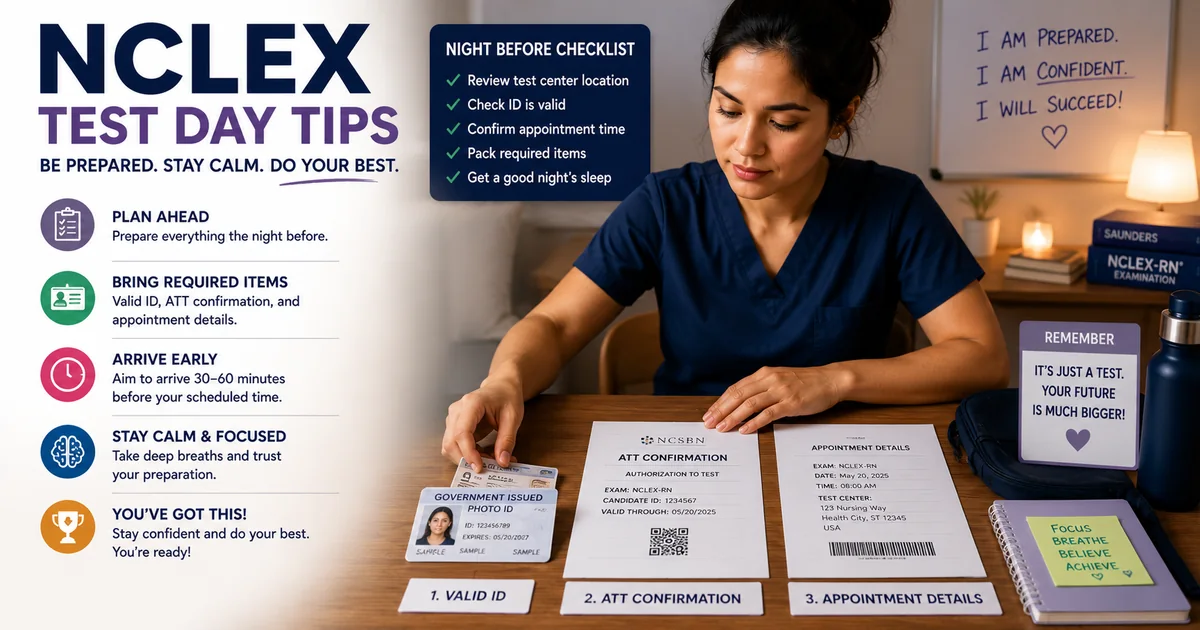
A short, light review of your personal weak-area notes is reasonable if it helps you feel settled. Starting a new topic block is not. Confirm your appointment details, including your test center’s exact address and start time, and plan your route with enough buffer for traffic or transit delays. Lay out what you’re bringing so the morning isn’t rushed, and prioritize getting reasonable rest over squeezing in one more practice set.
| Night Before | Test Morning |
|---|---|
| Confirm appointment time and location | Eat something before you go |
| Light review only, no new content | Bring required identification |
| Prepare what you’re bringing | Leave extra time for travel |
| Get to bed at a reasonable hour | Arrive at least 30 minutes early |
What to Bring to the NCLEX Testing Center

According to the official NCLEX exam day information published by NCSBN, candidates must present valid identification and follow the testing center’s current candidate rules to be admitted.
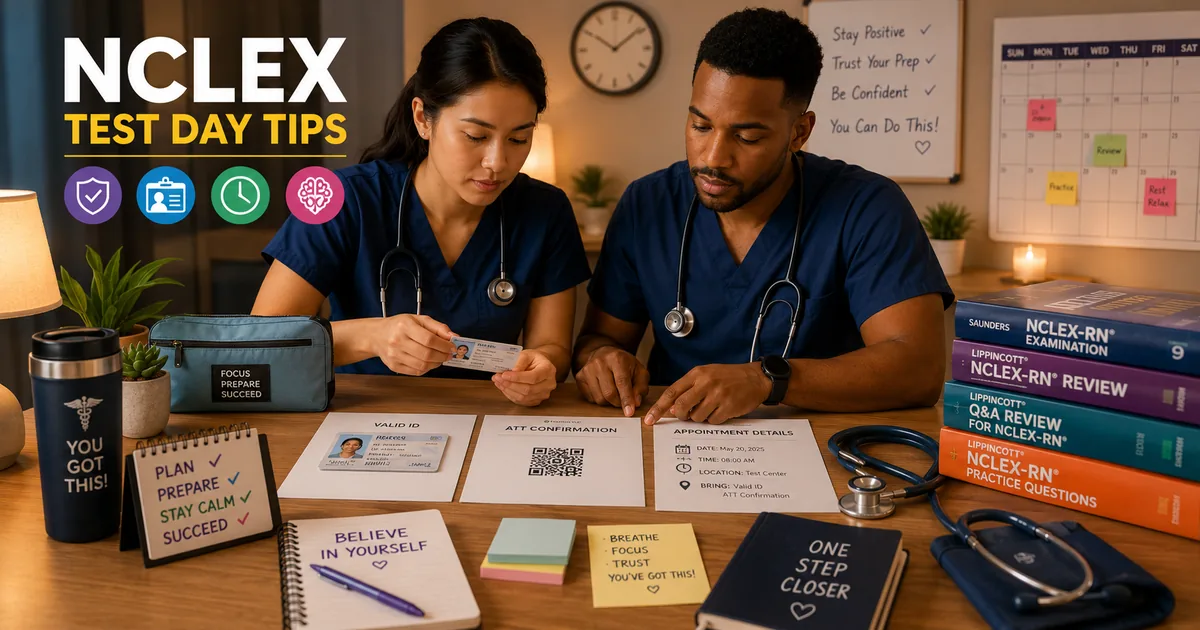
- Your Authorization to Test (ATT), if your jurisdiction requires you to reference it
- Government-issued photo identification with your signature, in physical form — digital IDs are not accepted
- A form of ID where your name matches your registration exactly, since even small discrepancies like a missing middle initial can result in you being turned away
- Nothing else. Study materials, notes, and personal items are not permitted in the testing room
Because ID requirements and accepted document types can vary by testing location and are updated periodically, check the current official NCLEX candidate information before your appointment rather than relying on general guidance alone.
What to Expect When You Arrive for the NCLEX
Plan to arrive at least 30 minutes before your scheduled time. NCSBN’s official exam day guidance notes that candidates arriving more than 30 minutes late may be required to forfeit their appointment and reregister with an additional exam fee.
Once inside, expect a formal check-in process. Staff will verify your identification, and current procedures require biometric data collection, including a signature, photograph, and palm vein scan, before you’re admitted to test. You’ll be asked to store personal electronic devices, including your phone, in a sealed bag provided by the testing center — refusing this step means you won’t be permitted to test that day. A security scanning protocol is also part of check-in, and applies again each time you leave and return from a break.
Dress comfortably, but be aware that hats, scarves, and heavy outerwear typically need to be left outside the testing room, with accommodations made for religious or cultural dress. None of this is designed to be intimidating — it exists to protect the integrity of a licensing exam that employers and boards rely on.
What Happens During the NCLEX?

Once you’re seated, you’ll be given an erasable note board and access to an on-screen calculator. The exam itself uses Computer Adaptive Testing, meaning the difficulty of each question adjusts based on how you’re answering, rather than presenting every candidate with the same fixed set of items.
Current NCSBN guidance allows candidates up to five hours to complete the exam, including any breaks taken. Once you submit a response, you cannot return to that question, so it’s worth taking a moment to read each item carefully rather than rushing through it. The exam ends once the system has gathered enough information to determine your result, which can happen at different points for different candidates — reaching more or fewer questions than another candidate doesn’t by itself indicate a pass or a fail.
You may also encounter Next Generation NCLEX item types on test day, including case studies and other formats built around clinical judgment rather than simple recall. If you’ve practiced these formats already, they shouldn’t feel unfamiliar, just a different rhythm than straightforward multiple choice.
How to Approach Questions on Test Day
Read the full question stem before jumping to the answer choices, including any patient data provided. Identify exactly what’s being asked — whether the question wants the priority action, the most likely cause, or the finding that requires immediate reporting changes which answer is correct even when the scenario looks similar to something you’ve seen before.
Watch for priority language like “first,” “best,” or “most important,” since these words often change the correct answer even when multiple options are technically true. Eliminate choices that are clearly inappropriate before comparing the remaining options closely, and lean on the clinical reasoning you’ve built rather than searching for a memorized rule that might not quite fit the scenario in front of you.
How to Manage Difficult NCLEX Questions
Every candidate encounters questions that feel harder than expected. That’s expected, and it isn’t necessarily a bad sign — a computer adaptive exam is designed to test you near the edge of your ability level, which means some discomfort is part of a normal test, not evidence that something has gone wrong.
Avoid changing an answer you’ve already reasoned through unless you have a clear, specific reason to reconsider it. Once you submit a response, resist replaying it in your head — you can’t return to it, and dwelling on a single difficult question tends to affect your focus on the next one more than it affects your actual result. Treat each question as its own decision, separate from how the last one felt.
NCLEX Breaks and Time Management
Breaks are part of the standard testing structure, and time spent on breaks counts against your overall five-hour limit rather than being additional time on top of it. If you need a break, raise your hand to notify the test administrator — you’ll need to leave the testing room and complete a palm vein scan again before resuming, consistent with current security procedures.
Because break policies and timing structures can be updated, review the current official NCLEX candidate rules ahead of your appointment so you know exactly what to expect rather than relying on secondhand descriptions. Pacing yourself early in the exam, rather than rushing through the first stretch of questions, tends to make the later portion of the test more manageable if you do end up testing toward the longer end of the time limit.
How to Manage Test-Day Anxiety
Feeling some nervous energy on exam day is normal, and it doesn’t mean you’re unprepared. A few practical habits help more than trying to eliminate the feeling entirely.
Arriving with time to spare removes one obvious source of stress before you’ve even checked in. Give yourself a moment to actually read each question rather than rushing out of anxiety, since rushing tends to cause more careless errors than slowing down does. If you’re offered a break and you’re feeling overwhelmed, take it rather than pushing through out of a sense that you should keep going. Stay focused on the question in front of you rather than mentally tallying how you think you’re doing, since that kind of running scorekeeping isn’t accurate and tends to add pressure without adding useful information.
What NOT to Do on NCLEX Test Day
| Avoid | Why It Matters |
|---|---|
| Cramming new content the morning of the exam | Adds stress without meaningfully improving readiness |
| Bringing prohibited items into the testing room | Can delay check-in or result in items being confiscated |
| Arriving without required identification | May result in forfeiting your appointment and exam fee |
| Refusing to store your phone as instructed | Can result in being denied entry to test |
| Dwelling on a previous question | Distracts focus from the question currently in front of you |
| Trying to count or interpret question difficulty during the exam | Not a reliable indicator of your result |
What to Do After Completing the NCLEX
The exam ends with a short exit survey about your testing experience — these questions don’t affect your result. After that, raise your hand and wait for the test administrator to dismiss you.
You won’t receive your result at the testing center. Official results are released through your state or territory’s board of nursing, and timing varies by jurisdiction. Some candidates check unofficial results through Pearson VUE’s Quick Results service where available, though this is a separate, optional service and not the official outcome. While you wait, it’s a reasonable time to make sure related administrative items, like reviewing your NCLEX exam fees records or confirming next steps with your board of nursing, are in order.
Final NCLEX Test Day Checklist
- Confirm your appointment time, location, and current ID requirements in advance
- Prepare required identification and anything officially permitted the night before
- Arrive at least 30 minutes early
- Expect biometric check-in, including a palm scan and photograph
- Store personal electronics as instructed
- Read each question fully before answering, and use available breaks if you need them
- Focus on one question at a time rather than tracking difficulty or count
- Complete the exit survey, then wait to be dismissed by the administrator
- Confirm how and when your results will be released through your board of nursing
Ready to Finish Your NCLEX Preparation With Confidence?

Test day logistics are only part of the picture — how you handle the exam content still matters most. Strengthen your reasoning with NCLEX practice questions, review clinical judgment strategies, or revisit the Next Generation NCLEX format if you haven’t already. If you want personalized guidance heading into your exam date, our NCLEX coaching for nurses program can help you walk in prepared.