30-Day NCLEX Study Plan: A Step-by-Step Preparation Schedule
Thirty days sounds tight when you’re staring down an exam that covers nearly every area of nursing practice. For some candidates, it’s genuinely enough time. For others, it’s a compressed version of a plan that would ideally run longer. A 30-day NCLEX study plan works best as a framework you adapt to where you’re actually starting from, not a rigid script everyone follows identically.
This guide walks through a realistic week-by-week structure, what to prioritize at each stage, and how to adjust the plan if your circumstances don’t match the default 30-day version. It’s meant to sit alongside a broader NCLEX preparation plan, not replace the fundamentals that plan is built on.
Is 30 Days Enough to Prepare for the NCLEX?
It depends heavily on where you’re starting from. A recent graduate with strong exam-readiness scores from nursing school and consistent practice-question performance can often use 30 days productively, especially if the plan is focused rather than scattered.
A candidate with significant content gaps, a longer gap since graduation, or a previous unsuccessful attempt may need more time, and that’s a legitimate reason to extend the plan rather than compress your review into fewer days than you actually need. Thirty days is a common target, not a guarantee, and no schedule by itself determines whether you pass.
Assess Your Starting Point Before You Begin

Before building a day-by-day schedule, take stock of where you actually stand. Consider how recently you graduated, how confident you feel across major content areas, and how you’ve performed on any diagnostic or practice questions you’ve already completed.
If you haven’t taken the NCLEX before, focus on identifying weak content areas early. If this is a repeat attempt, your prior candidate performance report is one of the most useful tools available — it tells you specifically which content areas need the most attention, rather than making you guess. Either way, resist the temptation to treat one strong practice-test percentage as proof you’re ready; it’s a data point, not a guarantee.
A Realistic Daily Study Structure
Before getting into the weekly breakdown, it helps to have a template for what a single study day can look like. This is a flexible example, not a fixed rule:
A focused content review session covering one topic area, a block of practice questions related to that topic, dedicated time reviewing rationales for both correct and incorrect answers, a short revision pass on a previously identified weak area, and a brief recall session revisiting material from earlier in the week.
Two to four focused hours, broken into blocks with real breaks in between, tends to produce better retention than a single unbroken eight-hour session. Consistency across 30 days matters more than the length of any individual day.
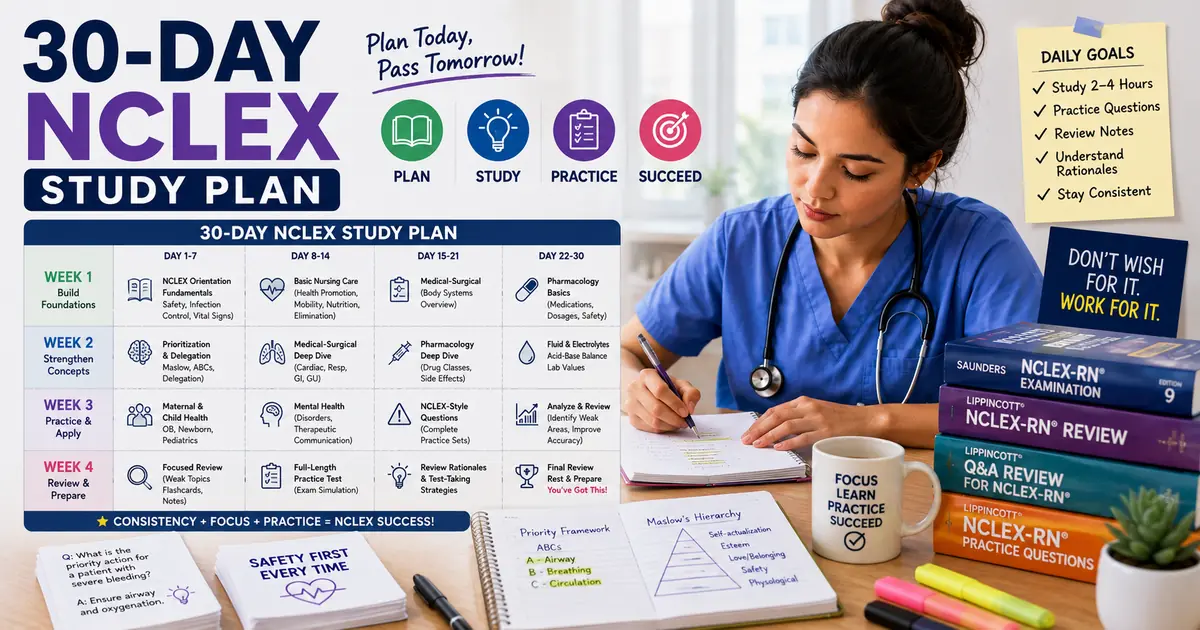
Week 1: Assessment and Foundational Review
The first week is about establishing your baseline and covering foundational content broadly rather than diving deep into any one area yet.
Start by reviewing major content categories at a survey level — fundamentals, medical-surgical concepts, pharmacology, and safety principles — while paying attention to which topics feel shaky. Begin daily practice questions immediately, even before you feel “ready,” since early questions reveal gaps faster than passive reading does.
Create an error log from day one. Every time you miss a question, note the topic, why you got it wrong, and what concept you need to revisit. This log becomes one of the most valuable tools in your entire 30 days, because it turns scattered mistakes into a focused list of what to fix.
Week 2: Focused Content and Application
By the second week, you should have a working list of weak areas from your error log. Shift your review time toward those specific topics instead of continuing a broad survey of everything.
Pharmacology deserves dedicated attention here, since it threads through nearly every other content area and tends to be where candidates lose the most points. Reviewing high-yield drug classes alongside the body systems they treat is more efficient than studying medications in isolation — our NCLEX pharmacology tips guide walks through exactly how to structure that review.
Keep working through fundamentals and med-surg concepts, but start layering in prioritization questions — which patient do you see first, which action comes first — since this kind of reasoning becomes central later in the plan. Continue daily practice questions, and start reviewing rationales more critically: not just why the correct answer was right, but why each distractor was wrong.
Week 3: Clinical Judgment and NGN Practice
This week shifts from content recall toward reasoning. Clinical judgment is the skill the modern exam is built around, and it’s worth treating as its own area of focused practice rather than something that develops automatically from content review alone.
Work through scenario-based and case-study questions deliberately, paying attention to how you recognize cues, prioritize competing needs, and evaluate outcomes. If you haven’t spent dedicated time with clinical judgment as its own topic, this is the week to do it, since these skills apply across nearly every content area rather than one narrow section.
This is also the right time to get comfortable with Next Generation NCLEX question formats specifically — bow-tie, matrix, extended multiple response, and case studies all have their own logic that’s worth practicing before exam day rather than encountering for the first time under pressure. Mix in extended multiple-response and select-all-that-apply style questions regularly this week, since they require a different answering strategy than single-best-answer items.
Week 4: Exam Readiness and Simulation
The final week is about consolidation, not new content. Resist the urge to start unfamiliar topics this late — it tends to create more anxiety than benefit, and your time is better spent reinforcing what you’ve already built.
Focus on mixed practice sessions that combine multiple content areas, similar to how the real exam will move between topics unpredictably. Revisit your error log one more time and prioritize the weak areas that have shown up repeatedly across the past three weeks. If you want a clearer sense of how the exam determines a result, it’s worth understanding how the NCLEX is scored so you’re not spending mental energy during the actual test trying to interpret question difficulty or count how many items you’ve answered.
Keep your study sessions shorter and more targeted as the week goes on. Protect your sleep in the final days — fatigue affects reasoning and focus far more than most candidates expect, and clinical judgment questions in particular require a clear head.
The Day Before the Exam

Avoid cramming new material the day before your test. At this point, additional content review has diminishing returns and often just adds stress. A light review of your personal weak-area notes is reasonable; starting a new topic block is not.
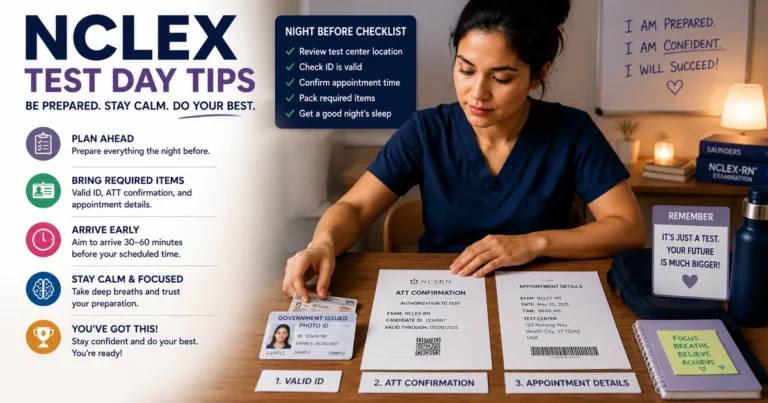
Confirm your logistics — your testing center location, required identification, and appointment time — so there’s nothing left to figure out on exam morning. Prioritize rest over squeezing in one more practice set. Walking in with a clear head consistently matters more than one additional hour of review.
How to Use Practice Questions Strategically

Throughout all four weeks, practice questions should be answered deliberately, not rushed through for a completion count. Working consistently through NCLEX practice questions only pays off if you’re pairing every session with genuine rationale review.
For each question, understand specifically why the correct answer was right and why each distractor was wrong, even on questions you answered correctly. A right answer reached through shaky reasoning is still a gap, and a slightly reworded version of that same question will expose it. Track recurring weak topics in your error log and revisit them again a few days later, since spaced review builds retention better than reviewing something once and moving on.
Common Mistakes on a Short Study Plan
Trying to cover everything with equal depth is one of the most common mistakes candidates make on a compressed timeline. Thirty days doesn’t allow for treating every content area identically — your error log should be actively steering where your time goes.
Skipping error review to answer more new questions is another frequent misstep. Volume without reflection doesn’t build the reasoning skills the exam actually tests. Similarly, avoiding clinical judgment and NGN-format practice until the final days leaves too little time to get comfortable with formats that behave differently from traditional multiple choice. And treating a single strong practice-test score as confirmation of readiness can create a false sense of security heading into exam day.
If you’re finding that your gaps are broader than a 30-day window can realistically close, extending your timeline is a reasonable adjustment, not a failure. Working with NCLEX coaching for nurses can also help you get an outside perspective on where your reasoning is breaking down, which is often harder to see clearly on your own.
Adapting the Plan to Your Situation

This 30-day structure is a starting framework, not a fixed rule. A candidate with a strong nursing foundation and consistent practice scores might spend proportionally more time in Weeks 3 and 4 on clinical judgment and mixed practice, since content review is less of a bottleneck for them.
A candidate with more significant content gaps may need to extend Weeks 1 and 2, even if that means the overall timeline runs longer than 30 days. If you’re working full-time or managing other responsibilities, shorter, more frequent study sessions spread across the day are often more sustainable than trying to protect one long block of time you can’t actually guarantee.
The National Council of State Boards of Nursing publishes the current test plan and examination details directly, and it’s worth reviewing that material yourself alongside any study plan to make sure your preparation reflects the version of the exam you’ll actually be taking.
Final Thoughts
A 30-day NCLEX study plan works when it’s treated as a structure you actively adjust, not a script you follow blindly regardless of how your practice performance looks along the way. Start with an honest assessment of where you stand, let your error log guide where your time goes, and shift from content recall toward clinical reasoning as your exam date approaches.
Consistency across four weeks, paired with genuine reflection on your mistakes, tends to matter more than any single study technique on its own.