

NCLEX Testing Accommodations (2026): Complete Guide for Candidates
If a documented disability or medical condition could affect your ability to test under standard conditions, NCLEX testing accommodations exist to give you appropriate access to the exam. They aren’t automatic, they aren’t guaranteed, and the process to request them needs to start well before you’d normally think about scheduling.
This guide walks through what accommodations exist, who may qualify, how the request process generally works, and what to understand before test day. Because approval runs through your specific nursing regulatory body (NRB) rather than a single universal system, this article focuses on the general framework — you’ll still need to follow your own board’s exact instructions once you begin.
What Are NCLEX Testing Accommodations?

NCLEX testing accommodations are approved adjustments to the standard testing environment or format, intended to give qualified candidates appropriate access to the exam without changing what the NCLEX actually measures. According to accommodation policies published by multiple state boards of nursing, accommodations are provided under the framework of the Americans with Disabilities Act (ADA) of 1990, which defines disability broadly to include physical or mental impairments that substantially limit one or more major life activities.
It’s worth being precise about what accommodations are not. They aren’t designed to make the exam easier or to lower the competency standard every candidate is measured against. The exam still evaluates the same clinical knowledge and judgment; an accommodation simply adjusts how the exam is delivered so a candidate’s documented condition doesn’t create an unfair barrier to demonstrating that competency. Our NCLEX Scoring and Passing Standard guide covers how the passing standard itself works, which stays the same regardless of any approved accommodation.
Who May Qualify for NCLEX Testing Accommodations?

Candidates with a documented disability that substantially limits a major life activity, as defined under the ADA, may be eligible to request accommodations. This is a broad legal framework rather than a fixed list of qualifying diagnoses, and eligibility is determined on a case-by-case basis by the relevant nursing regulatory body, generally based on documentation from a qualified professional rather than the candidate’s own description of their needs.
There isn’t a universal list of conditions that automatically qualify, and no accommodation is guaranteed simply because a request is submitted. Your specific board evaluates each request individually against its own criteria and the documentation provided, so the only reliable way to know whether your circumstances qualify is to go through your board’s actual request process.
Examples of NCLEX Testing Accommodations
Based on accommodation policies published by multiple state boards of nursing and Pearson VUE’s testing accommodation information, examples of accommodations that may be available, depending on approval, include additional testing time, a separate or private testing room, screen magnification or other visual display adjustments, and other approved arrangements suited to a candidate’s documented needs, such as sign language interpretation or accessible equipment.
It’s worth noting that some adjustments don’t require a formal accommodation request at all. Comfort items on Pearson VUE’s published comfort aid list, along with standard features like the on-screen calculator and erasable note board, are available to every candidate without prior approval. Formal accommodations are a separate, more individualized category, and not every candidate receives the same accommodation — what’s approved depends entirely on the specific documented need and your board’s determination.
How to Request NCLEX Testing Accommodations

The general sequence tends to follow this pattern, though exact steps vary by board:
- Identify the nursing regulatory body or jurisdiction you’re applying through.
- Review that board’s specific accommodation request requirements and forms.
- Determine what documentation is required to support your request.
- Submit the accommodation request through the process your board specifies, often alongside or shortly after your licensure application.
- Wait for a formal decision before making assumptions about your testing appointment.
- Follow the specific instructions provided once your request is approved.
- Complete scheduling only according to the process outlined for approved accommodations, which may differ from standard scheduling.
This is a distinct process from general NCLEX registration, and it typically needs to happen before or alongside your registration rather than as an afterthought.
What Documentation Is Needed for NCLEX Accommodations?

Documentation requirements vary by board, but a common pattern involves a signed statement from a qualified professional whose credentials are appropriate to the condition being documented, including a description of the diagnosis and how it specifically affects testing. Some boards also request records of accommodations previously granted in an academic setting, such as nursing school, as supporting evidence.
Because the exact documentation format, required forms, and acceptable professional credentials differ from board to board, there isn’t a single universal checklist that applies everywhere. Confirm the exact requirements directly with your specific nursing regulatory body before you begin gathering paperwork, since submitting the wrong format or incomplete information is one of the most common causes of delay.
When Should You Request NCLEX Testing Accommodations?

Start this process as early as possible, ideally well before you’d otherwise begin thinking about scheduling your exam. Some boards indicate an initial response to an accommodation request within a matter of business days, but full review, especially when additional documentation is needed, can take considerably longer, and processing times vary by jurisdiction and by the complexity of the request.
Waiting until close to when you want to test creates unnecessary risk. Because accommodations must typically be approved and reflected on your Authorization to Test before scheduling, a delayed request can push back your entire timeline, not just the exam date itself.
Do NCLEX Testing Accommodations Affect the NCLEX Passing Standard?
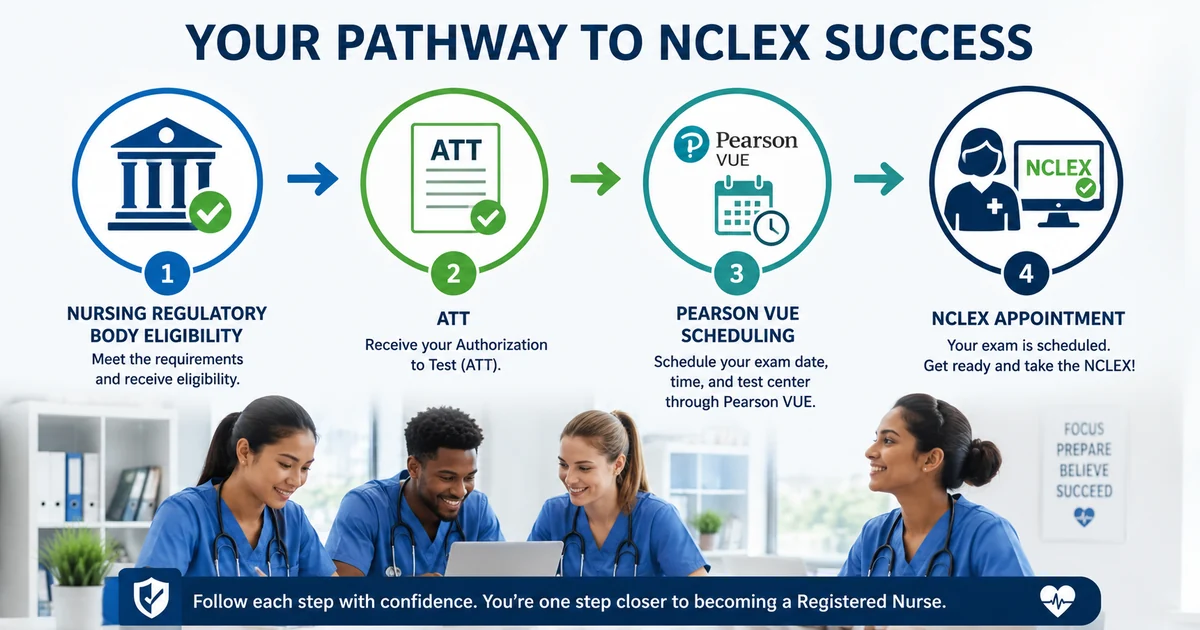
No. Accommodations are intended to provide appropriate access to the examination, not to change the level of nursing competency being measured. The distinction here matters: accessibility is about how the exam is delivered to you, while the passing standard is about what level of ability the exam is measuring against, and that standard stays the same for every candidate regardless of any approved accommodation.
If you want more detail on how the passing standard itself works, our NCLEX Scoring and Passing Standard guide covers the mechanics in full.
Can You Schedule the NCLEX Before Accommodation Approval?
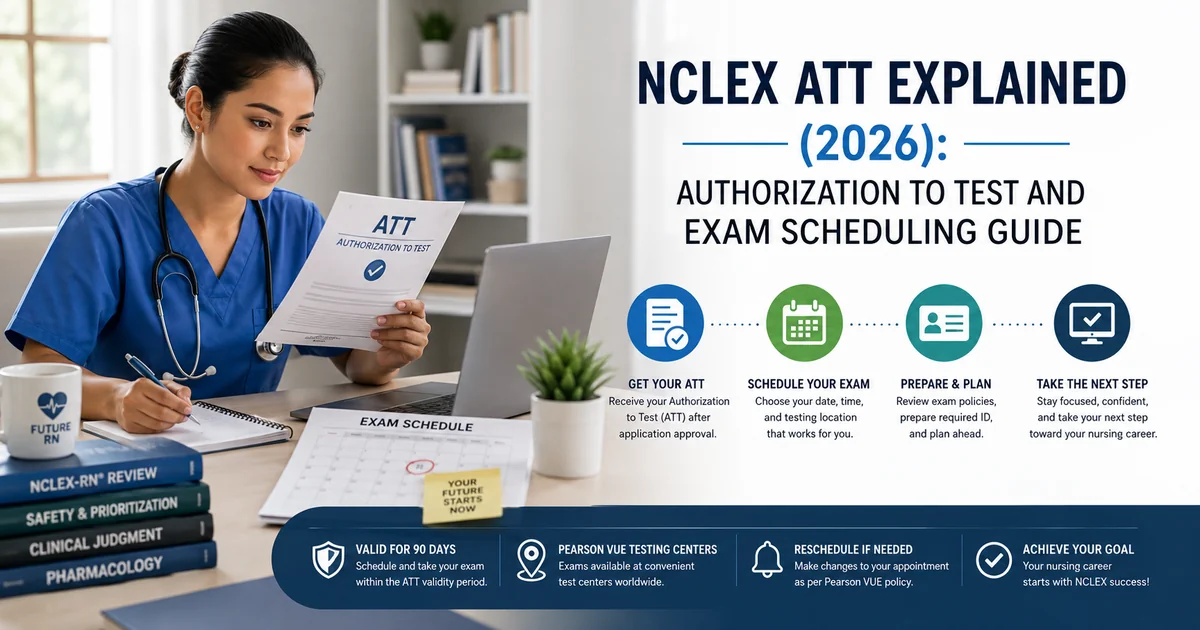
Generally, no. According to accommodation instructions published by multiple boards of nursing, candidates should not schedule an exam appointment until accommodations have been formally granted and reflected on the ATT, or until a final approval or denial decision has been communicated. Scheduling prematurely can create complications if your approved accommodation isn’t yet reflected in the system, or if it requires a different scheduling process than standard registration.
Because this coordination between accommodation approval and scheduling can vary depending on your board and Pearson VUE’s specific procedures, follow the exact instructions provided by your nursing regulatory body rather than scheduling based on assumptions. Our NCLEX ATT guide covers the general ATT and scheduling process if you want the broader context.
NCLEX Accommodations and International Nurses

Internationally educated nurses who need testing accommodations go through the same fundamental framework as any other candidate — the request is evaluated by the nursing regulatory body through which they’re seeking licensure, using that board’s specific requirements and documentation standards. There isn’t a separate accommodation system for international candidates specifically.
If you’re still working through the broader international licensure pathway, our NCLEX for International Nurses guide covers that process in more depth; this article focuses specifically on the accommodation request itself, which applies the same way regardless of where your nursing education took place.
NCLEX Testing Accommodations and Exam Day
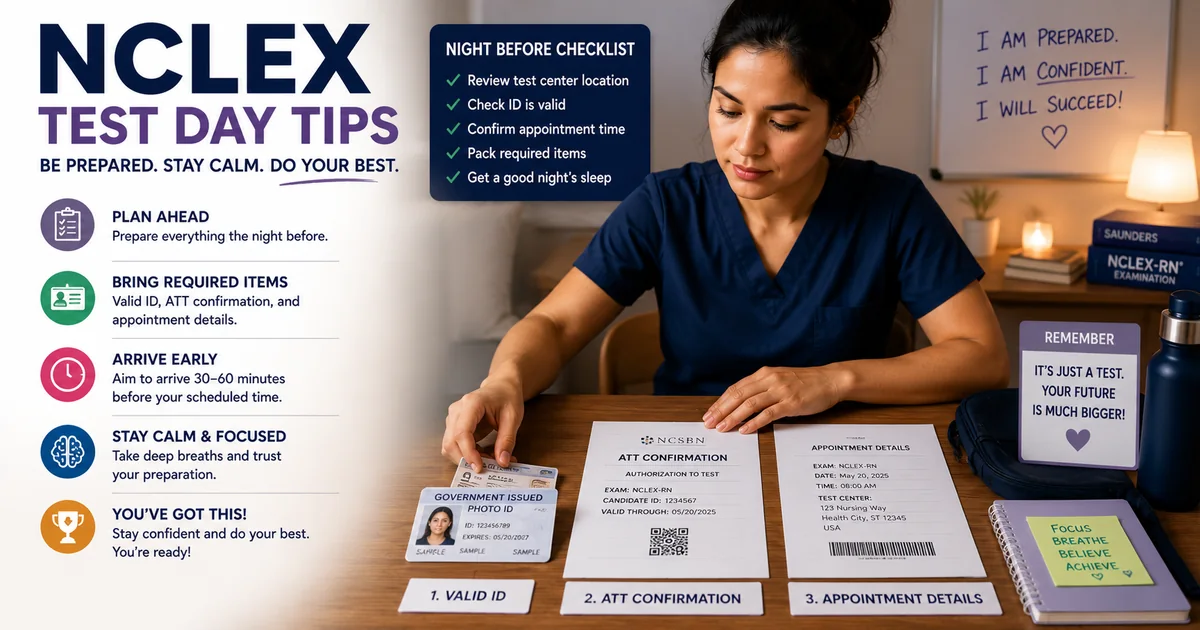
Once your accommodation is approved and reflected on your ATT, review exactly what was granted before your appointment so there are no surprises at the test center. Bring the same required identification any candidate needs, and confirm your appointment details match what was approved, since discrepancies between your ATT and what’s set up at the test center can cause delays.
Our NCLEX Test Day Tips guide covers the general check-in and exam-day process in detail. If anything about your approved accommodation doesn’t appear correct when you arrive, or your ATT doesn’t clearly reflect what was granted, raise it with test center staff immediately rather than assuming it will be sorted out automatically once testing begins.
Common Mistakes When Requesting NCLEX Accommodations

- Waiting until shortly before a desired exam date to start the accommodation request process
- Assuming approval is automatic simply because a request was submitted
- Submitting incomplete documentation or documentation that doesn’t meet the board’s specific format requirements
- Relying on unofficial websites or other candidates’ experiences instead of your own board’s published instructions
- Assuming an accommodation approved for a different exam or academic setting automatically transfers to the NCLEX
- Scheduling an exam appointment before accommodation approval is finalized and reflected on the ATT
- Not following the specific instructions provided by the nursing regulatory body after approval
- Assuming every jurisdiction uses identical forms, documentation standards, or timelines
NCLEX Testing Accommodations: Step-by-Step Checklist
- Identify your nursing regulatory jurisdiction.
- Review that board’s specific accommodation request requirements.
- Determine what documentation is required and from whom.
- Submit your accommodation request through the specified process.
- Wait for formal approval, denial, or a request for additional information.
- Register and schedule only according to the instructions provided for approved accommodations.
- Confirm the approved accommodation details are reflected on your ATT.
- Prepare for the exam content itself once logistics are settled.
- Attend your appointment, bring required identification, and follow test-center procedures.
Exact procedures, forms, and timelines vary by jurisdiction, so treat this as a general framework to adapt to your specific board’s instructions.
Ready to Continue Your NCLEX Preparation?

Once your accommodation request, if applicable, is settled and your exam is on the calendar, your focus can shift to preparation itself. Explore our complete NCLEX Preparation resources, or get personalized guidance through NCLEX Coaching as you work toward your exam date.