
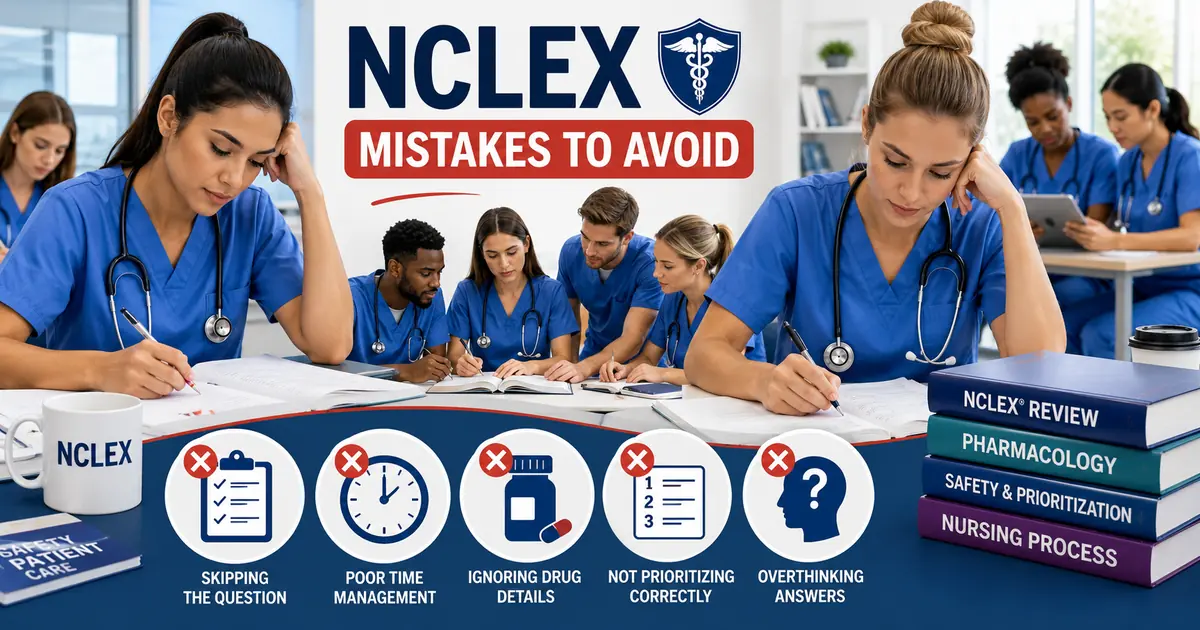
NCLEX Mistakes to Avoid: Common Errors That Can Hurt Your Preparation
Most candidates who struggle with the NCLEX aren’t lacking nursing knowledge. They’re often undone by a handful of preparation habits that quietly work against them for weeks before test day ever arrives. Knowing the most common NCLEX mistakes to avoid won’t guarantee a passing result on its own, but fixing them removes obstacles that have nothing to do with how much you actually know.
This article walks through thirteen of the most common errors candidates make, why each one happens, and what to do instead. If you’re building your study plan from scratch, pair this with our NCLEX preparation guide for the broader foundation these fixes sit on top of.
Why Avoiding NCLEX Preparation Mistakes Matters

Content knowledge and exam-day performance aren’t the same thing. A candidate can understand pharmacology and pathophysiology reasonably well and still underperform because their study habits, question strategy, or test-day decisions worked against them. Recognizing these patterns early gives you more time to correct course before they cost you momentum.
1. Studying Without a Clear NCLEX Study Plan
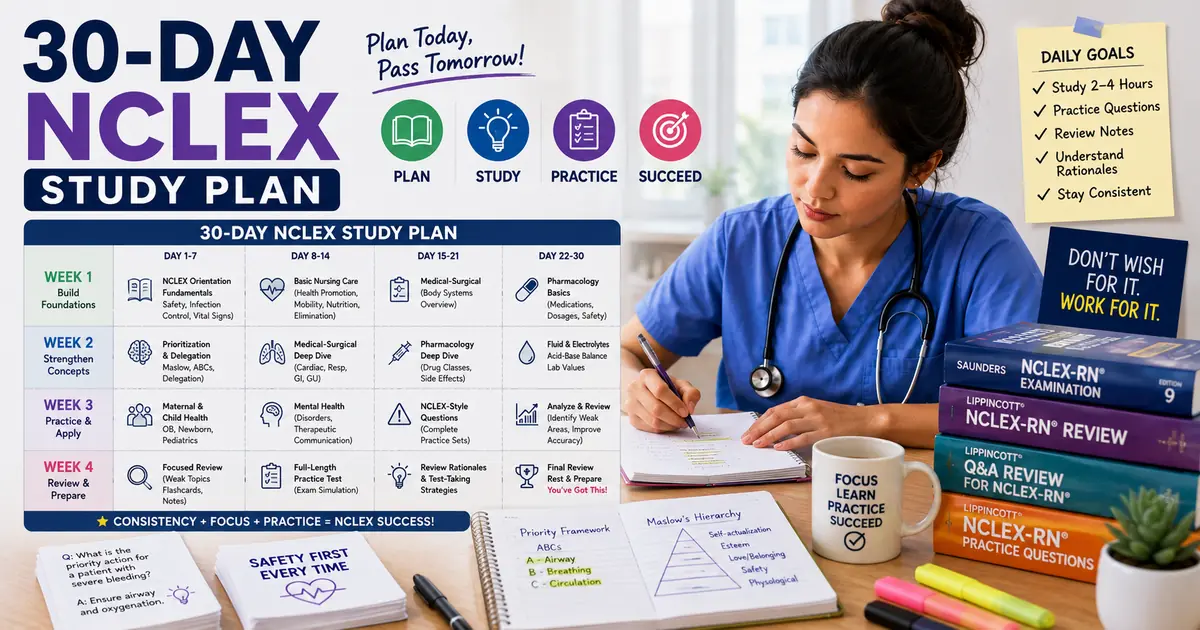
Candidates often start reviewing whatever content feels most urgent that day, without a structure guiding what gets covered and when. This feels productive in the moment but tends to leave gaps that only surface later, often close to the exam.
A structured approach, like a 30-Day NCLEX Study Plan adapted to your actual timeline, keeps your review balanced across content areas instead of following whatever feels most comfortable. The exact number of days matters less than having a plan you’re actually following.
2. Using Too Many NCLEX Study Resources
Switching between multiple review books, question banks, and video courses can feel thorough, but it often fragments your understanding instead of deepening it. Different resources organize content differently, which makes it harder to build a consistent mental framework.
Choosing one or two primary resources and using them consistently tends to produce better retention than sampling from five different sources without depth in any of them.
3. Memorizing Facts Without Understanding Clinical Application
It’s tempting to memorize isolated facts, like a single lab value or a drug’s classic side effect, without connecting them to a broader clinical picture. This works for flashcard-style recall but breaks down quickly on scenario-based questions.
The NCLEX increasingly tests clinical judgment rather than isolated recall, especially through Next Generation NCLEX case studies. Practice applying facts to realistic patient situations, not just retrieving them in isolation.
4. Doing Practice Questions Without Reviewing Rationales

Answering a question and immediately moving to the next one, without reading why the correct answer was right and why the others were wrong, wastes most of the value practice questions offer. The number of questions answered matters far less than what you actually learn from each one.
Slow down on NCLEX practice questions and treat rationale review as the real work, not an optional extra step.
5. Focusing on Question Quantity Instead of Learning Quality
Related to the mistake above, some candidates track their preparation almost entirely by how many total questions they’ve answered. A high number can create a false sense of readiness if most of those questions were never properly reviewed.
Quality of review, not volume of questions, is what actually closes knowledge gaps.
6. Ignoring Your Weak Areas
It’s natural to gravitate toward content that already feels comfortable, since practicing familiar material feels more rewarding than confronting a weak spot. Over time, this leaves your actual gaps untouched while you get incrementally better at things you already understood.
Deliberately tracking incorrect answers and revisiting those specific topics, rather than skipping past them, is one of the more efficient uses of limited study time.
7. Neglecting Clinical Judgment Practice

Some candidates treat clinical judgment as something that develops automatically from content review. It doesn’t always work that way, particularly for candidates more comfortable with recall-style learning than scenario-based reasoning.
Recognizing relevant findings, analyzing what they mean together, prioritizing competing needs, choosing an appropriate action, and evaluating the outcome are skills worth practicing directly, not assuming will develop on their own.
8. Relying on NCLEX Test-Taking Tricks
There’s no shortage of advice online about answer-selection patterns supposedly built into the exam. These tricks are unreliable, and relying on them instead of sound reasoning can lead you toward the wrong answer just as easily as the right one.
Read the question carefully, identify exactly what’s being asked, look for priority language, and use clinical reasoning grounded in the patient scenario in front of you. There’s no substitute for that.
9. Studying Inconsistently or Cramming
Long gaps between study sessions, followed by intense cramming close to the exam, tends to produce weaker retention than shorter, more consistent sessions spread across weeks. Cramming can feel productive in the moment while actually building a shallower understanding than steady review would.
Consistency across your preparation window matters more than the length of any individual session.
10. Using Outdated or Unreliable NCLEX Information
NCLEX policies, question formats, and scoring details have changed over the years, most notably with the rollout of the Next Generation NCLEX. Studying from outdated blog posts or older review materials can leave you unprepared for the current exam format.
When you need current, authoritative information on exam procedures or scoring, NCSBN’s official resources should take priority over secondhand summaries.
11. Comparing Your NCLEX Experience With Other Candidates
Because the NCLEX uses Computer Adaptive Testing, no two candidates take the exact same exam. Comparing your question count, difficulty level, or how the test “felt” against another candidate’s experience isn’t a meaningful way to judge your own performance, and it can create unnecessary anxiety around numbers that don’t actually predict a result.
12. Making Poor Test-Day Decisions
Preparation can be strong and still get undermined by poor decisions on exam day itself, like arriving without proper identification, rushing through questions out of nervousness, or repeatedly second-guessing answers without a clear reason to change them.
Reviewing NCLEX test day tips ahead of time removes some of this risk before it becomes a factor.
13. Failing to Adjust Your Strategy After an Unsuccessful Attempt

Repeating the same preparation approach after an unsuccessful attempt, without examining what actually went wrong, tends to produce a similar result. This is understandable — revisiting a difficult outcome isn’t easy — but it usually doesn’t change the underlying gap.
Reviewing your NCLEX Candidate Performance Report closely and adjusting your study plan around what it actually shows gives your next attempt a genuinely different foundation to build from.
How to Replace These NCLEX Mistakes With Better Habits
| Common Mistake | Why It Can Be a Problem | Better Approach |
|---|---|---|
| Studying without a plan | Leaves content gaps until it’s too late to fix them | Follow a structured, adaptable study schedule |
| Skipping rationale review | Repeats the same errors on similar questions | Review every rationale, correct and incorrect |
| Avoiding weak areas | Leaves real gaps untouched | Track and revisit specific weak topics |
| Relying on test-taking tricks | Unreliable and can lead to wrong answers | Use careful reading and clinical reasoning |
| Repeating the same strategy after failing | Often produces a similar result | Adjust the plan based on CPR results |
Final NCLEX Mistake-Prevention Checklist

- Build a structured, realistic study schedule rather than studying at random
- Use one or two primary resources instead of switching between many
- Pair content review with practical, scenario-based application
- Review rationales for every practice question, not just the ones you miss
- Track weak areas deliberately and revisit them on a schedule
- Practice clinical judgment directly rather than assuming it develops on its own
- Avoid test-taking tricks and rely on careful reading and reasoning instead
- Study consistently across weeks rather than cramming close to the exam
- Rely on current, authoritative sources for exam policies and procedures
- Prepare specifically for test-day logistics, not just content
- If retaking the exam, adjust your strategy based on your actual results

None of these mistakes are unusual, and making one of them doesn’t determine your outcome on its own. What matters is recognizing the patterns early enough to adjust, whether that means building more structure into your study schedule, slowing down on rationale review, or approaching a retake differently than your first attempt. Avoiding these errors won’t replace solid content knowledge and consistent practice, but it removes obstacles that have nothing to do with how much nursing knowledge you actually have.
Ready to Strengthen Your NCLEX Preparation?
Avoiding these mistakes is one part of a larger preparation strategy. Build a complete foundation with NCLEX preparation, sharpen your reasoning with NCLEX practice questions, or focus on clinical judgment if that’s where your gaps lie. If you’d like structured, personalized support, our NCLEX coaching for nurses program can help you build a plan around your specific needs.