
NCLEX Candidate Performance Report: How to Read and Use Your CPR
If you’ve just received a Candidate Performance Report, the first read-through can feel disorienting. It’s not a score, it doesn’t tell you a percentage, and it arrives at a moment that’s already emotionally difficult. The NCLEX Candidate Performance Report exists to help you prepare more effectively for your next attempt, but only if you know how to actually read it.
This guide explains what the CPR shows, how to interpret it accurately, and how to turn it into a focused study plan rather than a source of guesswork or unnecessary panic. If you’re rebuilding your preparation from here, our NCLEX preparation for nurses guide covers the broader foundation this report should feed into.
What Is the NCLEX Candidate Performance Report?

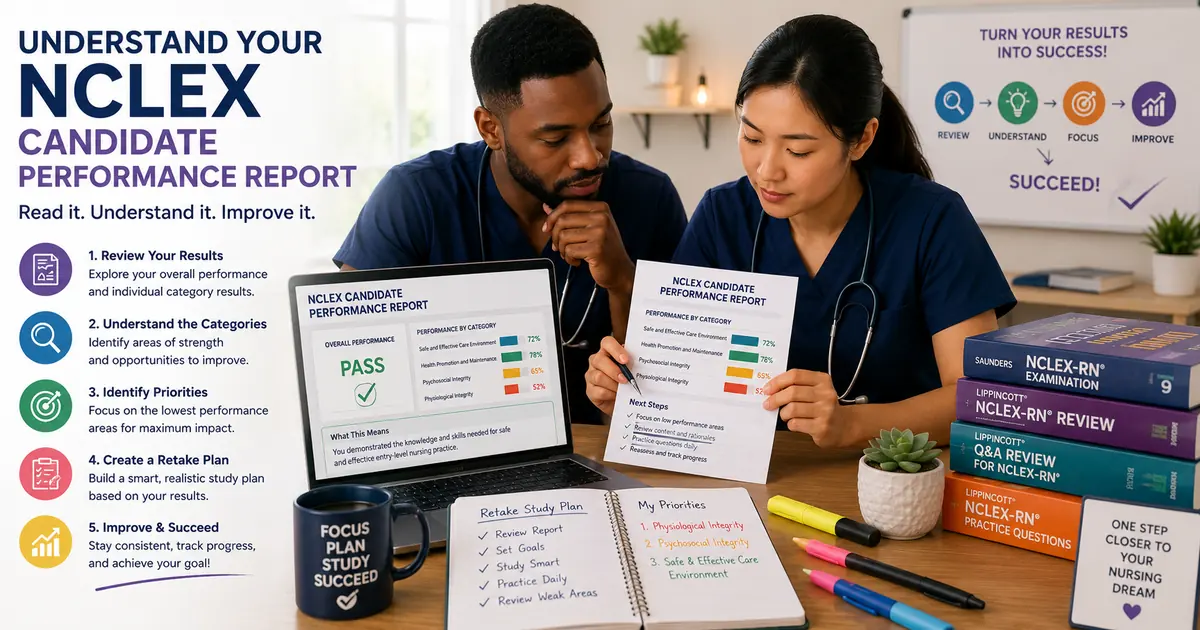
According to the official NCLEX information published by NCSBN, the Candidate Performance Report is a diagnostic tool provided to candidates who did not pass the exam. It breaks your performance down by content area, giving you a sense of where your preparation was strongest and where it needs the most work before you test again.
It is not a numerical score, and it isn’t designed to function like one. Its purpose is specifically to guide your next round of study, not to quantify exactly how close you came to passing.
Who Receives a Candidate Performance Report?

Candidates who do not pass the NCLEX receive a CPR. Candidates who pass do not receive one, since a passing result doesn’t require the same diagnostic detail — you’ve already demonstrated the competency the exam is designed to confirm.
There’s one additional detail worth knowing: candidates who fail the exam after answering fewer than the required minimum number of questions receive an abbreviated version of the report, since the exam wasn’t able to gather enough information across every content area to produce a full breakdown.
What Information Does the NCLEX CPR Show?
The report organizes your performance by the content categories defined in the current NCLEX Test Plan, the same framework the exam itself is built around. For each category, your performance is described using one of three designations, rather than a number or percentage.
This design is intentional. Because the NCLEX uses Computer Adaptive Testing, no two candidates answer the same set of questions, which makes a raw percentage across categories a poor way to communicate performance. Comparing your ability estimate to the passing standard in each area gives a more meaningful picture than counting correct answers would.
How to Read Your NCLEX Performance Report
Start by reading the entire report once without trying to act on it immediately. It’s common to jump straight to the categories that feel most concerning, but a full read gives you a more accurate overall picture before you start planning.
Once you’ve read it through, go back and separate your results into groups. Some categories will be marked as needing significant additional preparation, others as close to where they need to be, and others as solidly developed. Treat this as your starting map, not a final judgment on your abilities.
What Do the Performance Categories Mean?
The official CPR describes your performance in each content area using three designations: Below the Passing Standard, Near the Passing Standard, and Above the Passing Standard.
| Category | What It Suggests | How to Use It |
|---|---|---|
| Below the Passing Standard | This area needs the most focused rebuilding | Prioritize this content first in your new study plan |
| Near the Passing Standard | You’re close, but not yet consistent | Reinforce with targeted practice and rationale review |
| Above the Passing Standard | This area is comparatively strong | Maintain it with periodic review rather than heavy new study time |
According to NCSBN’s official guidance, candidates should concentrate first on areas listed as below the passing standard and work up toward those near it. Even categories marked above the passing standard are worth revisiting periodically, simply to maintain the proficiency you’ve already built rather than letting it slide during a retake preparation period.
CPR vs NCLEX Passing Score: What Is the Difference?
This is one of the most important distinctions to understand, and it’s a common source of confusion. The CPR is not the same thing as your NCLEX passing score outcome, and you shouldn’t try to reverse-engineer a pass/fail margin from it.
Your overall pass/fail result is determined by whether your total ability estimate consistently stayed above or below the exam’s passing standard across the whole test. The CPR, by contrast, only shows you category-by-category detail after an unsuccessful attempt — it’s diagnostic information layered on top of that result, not an explanation of exactly how close the number came to passing. Being “near the passing standard” in a category doesn’t mean you were a single question away from passing overall, and it isn’t a reliable predictor of how a future attempt will go.
How to Use Your CPR to Identify Weak Areas
Once you’ve grouped your results, look for patterns rather than treating each category as an isolated issue. If several related categories are all marked below or near the passing standard, that often points to a broader gap rather than several unconnected weaknesses.
It also helps to ask what kind of weakness you’re actually looking at. A low result in a content area could reflect a gap in content knowledge, difficulty interpreting what questions were asking, weak clinical reasoning under scenario-based formats, or inconsistent test-taking strategy. The CPR tells you where the weakness showed up; figuring out why is the next step, and it’s the step that actually shapes what you study differently this time.
How to Turn Your CPR Into a New NCLEX Study Plan
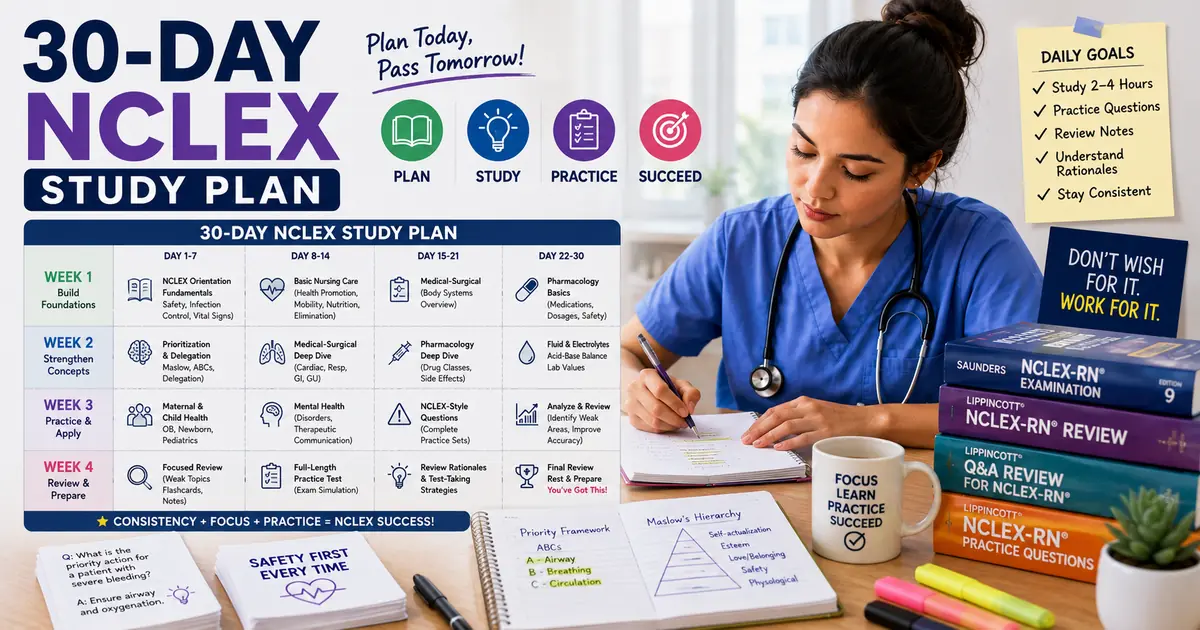
Once you understand which categories need the most attention and why, you can build a study plan that reflects your actual gaps instead of restarting from the beginning as if nothing from your first attempt mattered.
A structured 30-Day NCLEX Study Plan can be adapted around your CPR results by allocating more time to categories marked below the passing standard early on, then layering in near-passing categories as those strengthen. This is a more efficient use of your preparation time than spreading effort evenly across every topic regardless of where your actual weaknesses lie.
How Practice Questions Can Help Improve Weak Areas

Once you know which categories need work, resist the instinct to simply answer more questions overall. Volume without focus tends to reinforce the same gaps rather than close them.
Instead, direct your NCLEX practice questions specifically toward the categories your CPR flagged, and slow down on rationale review for each one. Understand not just why the correct answer was right, but why every distractor was wrong. Track which specific concepts keep tripping you up within a weak category, since a broad category label like “pharmacological therapies” can still hide a narrower, more specific gap underneath it.
How to Improve Clinical Judgment After an Unsuccessful Attempt

If your weak areas seem to span multiple content categories rather than one specific topic, that pattern often points toward clinical judgment rather than a content gap. This is common, and it’s worth addressing directly rather than continuing to review content you may already know reasonably well.
Focused practice with clinical judgment means deliberately working through the skills of recognizing important findings, analyzing what they mean together, prioritizing competing problems, deciding on the right action, and evaluating whether that action actually helped. Reviewing these steps explicitly, rather than assuming they’ll improve automatically through more content study, tends to produce a more noticeable shift in performance across a retake.
Common Mistakes When Interpreting the NCLEX CPR
Trying to calculate an exact pass/fail margin from the CPR is one of the most common mistakes, and it’s simply not what the report is built to show. Similarly, assuming a “near the passing standard” result means you were almost guaranteed to pass overlooks how the exam’s overall scoring actually works.
Another mistake is treating every category with equal urgency, which can spread your limited preparation time too thin. Ignoring categories marked above the passing standard entirely is a smaller but still meaningful mistake — those areas benefit from maintenance, even if they don’t need rebuilding. And perhaps most understandably, some candidates let a difficult CPR read discourage them from continuing preparation altogether, when the report’s actual purpose is to make that preparation more targeted, not to signal that success isn’t possible.
NCLEX Retake Preparation: What to Do Next
Before diving back into study material, it’s worth honestly identifying why your previous preparation fell short. That could involve content gaps, not enough deliberate practice with challenging question types, underdeveloped clinical judgment, shallow rationale review, an inconsistent study schedule, difficulty with Next Generation NCLEX formats specifically, or test-day factors like time management or anxiety. Most candidates find it’s a combination of a few of these rather than just one.
From there, build a plan around your actual CPR results rather than repeating your previous approach unchanged. If you found it difficult to identify what went wrong or how to restructure your study time on your own, working with NCLEX coaching for nurses can provide an outside perspective on patterns that are often harder to see clearly from the inside.

Final Thoughts
A Candidate Performance Report can feel discouraging in the moment it arrives, but its actual function is practical: it tells you where to concentrate your next round of preparation instead of leaving you to guess. Read it fully, group your results into real patterns, and build a study plan that reflects what the report is actually telling you rather than what your first reaction to it might be.