
NCLEX Passing Score 2026: How the NCLEX Is Scored
One of the most common questions nursing candidates ask before test day is deceptively simple: what’s the NCLEX passing score? If you’re expecting a number like “75% correct” or “700 out of 1000,” the honest answer is that the exam doesn’t work that way at all. The NCLEX passing score is based on a statistical model, not a percentage, and understanding that difference will change how you think about your performance on exam day.
This guide breaks down exactly how NCLEX scoring works, what the passing standard actually means, and why two candidates can answer completely different numbers of questions and both still pass.
Is There a Specific NCLEX Passing Score?
No. There is no fixed percentage or point total that candidates need to hit. Instead, the NCLEX-RN and NCLEX-PN are scored against a passing standard expressed in a unit called a logit.
According to the National Council of State Boards of Nursing (NCSBN), the Board of Directors voted to uphold a passing standard of 0.00 logits for the NCLEX-RN, and -0.18 logits for the NCLEX-PN, a standard that remains in effect through March 31, 2029.
A logit isn’t a percentage or a raw score. It’s a measurement on a scale that compares your demonstrated ability to the difficulty of the questions you’ve answered. You never see this number, and you don’t need to calculate it yourself — the computer does that in real time as you test.
How Does NCLEX Scoring Work?

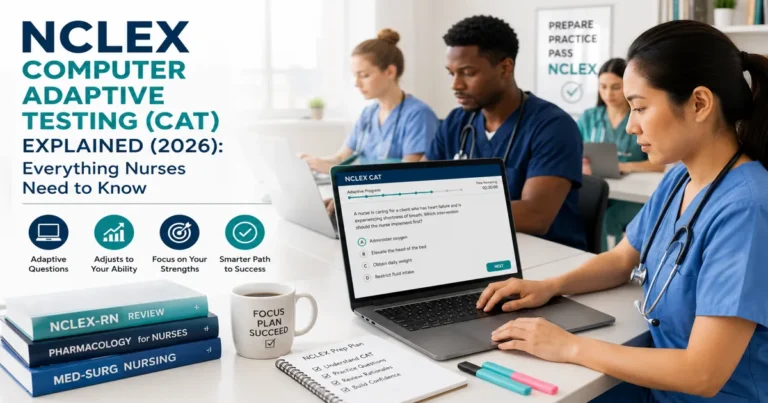
The NCLEX uses Computer Adaptive Testing (CAT). Instead of giving every candidate the same fixed set of questions, the exam selects each new question based on how you answered the one before it.
Here’s the basic mechanic:
- You start with a question of moderate difficulty.
- Answer it correctly, and the next question tends to be slightly harder.
- Answer it incorrectly, and the next question tends to be slightly easier.
With every response, the system updates its estimate of your ability level and narrows its confidence interval around that estimate. This is why candidates who want a deeper breakdown of the mechanics behind this system often benefit from reviewing Computer Adaptive Testing in more detail, since it directly shapes how your exam unfolds question by question.
Does Getting Difficult Questions Mean You Are Passing?
Not necessarily, but it’s not a bad sign either. The CAT engine gives you harder questions specifically because you’re answering well. If your ability estimate is trending above the passing standard, the system responds by raising the difficulty to keep testing you near your actual skill level.
The reverse is also true. If you’re missing questions, the difficulty tends to ease off. Neither pattern by itself tells you whether you passed. What matters is where your final ability estimate lands relative to the passing standard when the exam ends, not how hard any single question felt in the moment.
Does the Number of Questions Determine Whether You Pass?
This is one of the most persistent points of confusion, so it’s worth being direct: the number of questions you receive does not determine your result.
The NCLEX-RN has a minimum of 85 questions and a maximum of 150 questions. Candidates can pass or fail at either end of that range. Someone who finishes at 85 questions might have passed because the system reached 95% confidence quickly, or failed for the same reason. Someone who reaches all 150 questions isn’t automatically in trouble — it usually just means their ability estimate stayed close enough to the passing standard that the algorithm needed the maximum number of data points to make a confident decision.
What Is the NCLEX Passing Standard?
The passing standard is the benchmark your ability estimate has to consistently exceed. NCSBN sets this standard through a formal process that includes expert practice-analysis panels and a Board of Directors vote, and it’s reviewed on a recurring cycle to make sure it still reflects the competencies expected of entry-level nurses.
The exam uses what’s known as the 95% confidence rule as its primary stopping mechanism. Once the system is 95% statistically confident that your ability is either above or below the passing standard, the exam ends. If that confidence level isn’t reached by the maximum number of questions, your final ability estimate at that point determines the outcome. And if you run out of time before answering the minimum number of required questions, you fail automatically, regardless of how well you were doing.
How Clinical Judgment Affects NCLEX Performance

Since the rollout of the Next Generation NCLEX, scoring isn’t only about whether an answer is right or wrong. Many of the newer item types use polytomous scoring, which allows for partial credit rather than a strict binary outcome.
This matters because these questions are built to measure clinical judgment specifically — your ability to recognize cues, prioritize actions, and evaluate outcomes in a realistic patient scenario, not just recall an isolated fact. If you haven’t reviewed how these newer formats work, it’s worth spending time with a dedicated Next Generation NCLEX resource before test day, since these items make up a meaningful part of how your overall ability estimate is calculated. Building genuine reasoning skills through resources focused on NCLEX clinical judgment tends to move your ability estimate more reliably than memorizing content in isolation.
What Happens When the NCLEX Stops?
The exam can end in one of three ways, and NCSBN refers to these as stopping rules.
The most common is the 95% confidence rule described above — the exam ends as soon as the system is statistically confident about your result, whether that’s a pass or a fail. The second is the maximum-length rule, which applies if you reach the highest number of allowed questions without the system reaching that confidence threshold; in that case, your final ability estimate decides the outcome. The third is the run-out-of-time rule. If you haven’t answered the minimum number of required questions when time expires, you fail automatically. If you have met the minimum, your existing responses are evaluated to determine the result.
Can You Fail the NCLEX With a High Percentage of Correct Answers?
Yes, and this surprises a lot of candidates. Because the exam continuously adjusts difficulty based on your responses, a high percentage of correct answers on easier questions doesn’t carry the same statistical weight as consistent performance on harder ones.
If your ability estimate drifts below the passing standard, even after a string of correct answers earlier in the test, the final result reflects where that estimate lands, not your overall percentage correct across the whole session. This is exactly why raw “percentage correct” thinking doesn’t translate well to how the NCLEX actually scores candidates.
How to Prepare for the NCLEX Passing Standard

Because the passing standard isn’t about hitting a percentage, your preparation should focus on consistency at a higher difficulty level rather than chasing perfect scores on easy practice sets.
A few practical steps make a real difference:
- Practice with a mix of traditional and NGN-format questions so both scoring systems feel familiar
- Review the rationale behind every question you get wrong, not just the correct answer
- Take full-length timed practice exams to build stamina for tests that run toward the maximum question count
- Work through a structured NCLEX preparation plan rather than studying at random
If you’re looking for more guidance on pacing your review and building toward exam day, our full NCLEX preparation for nurses guide walks through a complete study timeline. Candidates who want structured feedback on their reasoning, rather than just more practice questions, often benefit from working with NCLEX coaching for nurses to identify blind spots before exam day.
Common NCLEX Passing Score Myths

“You need 75% correct to pass.” There is no fixed percentage. The exam is scored against a logit-based passing standard, not a percent-correct threshold.
“Fewer questions means you failed.” Not true. Finishing at the minimum number of questions can reflect a confident pass just as easily as a confident fail.
“Harder questions mean you’re failing.” The opposite is usually closer to reality — difficulty tends to rise when you’re performing well, since the system is testing near your actual ability level.
“The maximum number of questions means you’re in trouble.” Reaching the maximum simply means your ability estimate stayed close enough to the passing standard that the system needed more data before making a final decision.
“You can calculate your own score afterward based on how it felt.” Because the passing standard and your ability estimate aren’t visible during testing, there’s no reliable way to self-assess your result from question difficulty or how the exam “felt.”
What Should You Do After the NCLEX?
Once testing ends, there’s genuinely no way to know your result by counting questions or replaying how difficult the exam felt. Results are released through the official channels used by your state board of nursing, and unofficial results are sometimes available faster through the Pearson VUE Quick Results service, depending on your state.
While you wait, it’s a good time to make sure any remaining administrative steps, such as confirming your NCLEX registration status or reviewing your state’s requirements, are fully in order so there’s nothing left pending once your official result is released.
Final Thoughts
The NCLEX passing score isn’t a number you’re chasing — it’s a standard your demonstrated ability needs to consistently exceed, measured through a statistical model most candidates never fully see. Once you understand that question count, difficulty, and percentage correct don’t directly predict your outcome, you can stop trying to read tea leaves during the exam and focus on what actually matters: answering each question as accurately and thoughtfully as you can, one at a time.
If you’re building your study plan around how the exam is actually scored, the next step is applying that understanding to real practice. Explore structured NCLEX practice questions, review the Next Generation NCLEX format in depth, or work on your reasoning skills through our NCLEX clinical judgment resources. If you’d rather have direct feedback on your readiness, our NCLEX coaching for nurses program is built to help you close specific gaps before exam day.