
NCLEX Pharmacology Tips for Nurses: How to Study Medications and Answer Drug Questions
Ask any recent NCLEX candidate which content area gave them the most trouble, and pharmacology comes up more than almost anything else. It’s not because the concepts are impossible — it’s because there are hundreds of medications to know, and most candidates try to memorize their way through it instead of studying it strategically. These NCLEX pharmacology tips are built around how the exam actually tests medication knowledge, not just how much of it you can recall.
This guide walks through what to prioritize, how to organize your review, and how to think through a pharmacology question when you’re staring at one on screen. If pharmacology has been the weak spot in your NCLEX preparation, this is the place to fix it.
Why Pharmacology Matters on the NCLEX
Pharmacological and Parenteral Therapies is one of the largest single content categories on the exam, typically making up somewhere in the range of 12% to 18% of your test items, depending on the current NCSBN test plan. That’s a meaningful share of your exam on its own, and it doesn’t count the medication content that shows up embedded inside Next Generation case studies covering other body systems.
In other words, pharmacology isn’t a section you can review once and move past. It threads through nearly every other content area, from cardiovascular care to mental health, which is exactly why candidates who treat it as a standalone topic tend to underprepare for it.
How to Study Pharmacology for the NCLEX

The instinct most candidates have is to open a massive drug list and start memorizing names. That approach burns out fast and doesn’t transfer well to exam-style questions.
A more sustainable approach starts with function before names. Before you memorize a specific drug, understand what problem its entire class is designed to solve. Once you understand what a beta-blocker does physiologically, you can reason through almost any drug in that class, even ones you haven’t specifically reviewed before.
Focus on High-Yield Medication Concepts
Not every drug carries equal weight on the exam. A handful of categories — anticoagulants, antihypertensives, antibiotics, insulin and other endocrine medications, and psychiatric drugs — show up repeatedly because they’re common in practice and carry real safety risk if mismanaged.
For each high-yield medication, you should be able to answer five questions without hesitation: What is it for? What’s the most dangerous adverse effect? What lab value or vital sign do you monitor? What would make you withhold it? And what does the patient need to know before going home on it?
Learn Medications by Drug Class

Studying by class instead of by individual drug name is one of the most effective shifts a candidate can make. Instead of memorizing a hundred separate drugs, you’re learning a much smaller number of patterns and then noting how individual drugs within that class deviate from the pattern.
For example, once you know the core safety profile of ACE inhibitors as a class, you only need to remember that the “-pril” suffix marks the class and that a persistent dry cough is the hallmark adverse effect worth flagging. That’s a far more efficient way to hold hundreds of medications in memory than treating each one as an isolated fact.
Pay Attention to Adverse Effects
Adverse effects are where pharmacology questions get their teeth. The exam frequently asks which finding a nurse should report immediately, and the correct answer usually hinges on whether that finding represents an expected side effect or a genuine safety concern.
This is also where candidates lose points unnecessarily. Reading a case description carefully — the timing, the severity, the patient’s other risk factors — often matters more than knowing the drug itself. A slightly elevated but stable value might be expected; the same value trending sharply upward alongside new symptoms is a different clinical picture entirely.
Understand When a Medication Should Be Held
Knowing when to withhold a dose is one of the clearest ways the NCLEX tests clinical judgment through pharmacology. Certain patterns come up again and again: holding digoxin for a heart rate below a defined threshold, holding an anticoagulant before a scheduled invasive procedure, or holding insulin when a patient’s blood glucose has already dropped into a dangerous range.
The exam wants to see that you understand the reasoning behind the hold, not just the isolated rule. If you can explain why a parameter matters physiologically, you’ll be able to reason through unfamiliar medications using the same logic instead of relying purely on recall.
Connect Pharmacology With Patient Safety
Medication safety isn’t a separate topic from pharmacology — it’s the lens the exam uses to test it. Questions frequently center on the rights of medication administration, look-alike or sound-alike drug names, high-alert medications, and situations where a nurse needs to catch a prescribing error before it reaches the patient.
If you want a deeper, more authoritative reference point for medication safety principles, resources like MedlinePlus and the FDA provide accurate, current information on drug safety that goes beyond what most review guides summarize.
Do Not Ignore Patient Education

Patient teaching questions get skipped over by a lot of candidates because they feel less technical than adverse-effect questions, but they show up constantly. What should a patient watch for at home? What should they avoid combining with this medication? When should they call their provider instead of waiting it out?
If you can only describe a drug’s mechanism but can’t explain it in plain language a patient would actually understand, that’s a sign your review has stayed too technical. Practice translating each high-yield medication into two or three sentences you could say directly to a patient.
How to Answer NCLEX Pharmacology Questions
When a pharmacology question appears, resist the urge to jump straight to the drug name. Read the full scenario first — the diagnosis, the patient’s other conditions, and any recent lab or vital sign data included in the stem often change which answer is correct.
Next, identify what the question is actually asking. “Which finding requires immediate action” is a different question than “which finding is expected,” even if both reference the same medication. Confusing those two framings is one of the most common ways candidates miss otherwise straightforward questions.
Finally, apply clinical judgment rather than pure recall. This is where NCLEX clinical judgment skills directly intersect with pharmacology: you’re not just retrieving a fact, you’re weighing the patient’s full clinical picture to decide what matters most right now.
Common Pharmacology Mistakes on the NCLEX

Candidates repeatedly fall into a few avoidable traps. Memorizing brand names without understanding drug classes leaves you stuck the moment an unfamiliar name appears. Studying medications in isolation from the disease processes they treat makes it hard to reason through case-based questions. And skipping normal lab values means you can’t recognize when a monitoring parameter has actually crossed into dangerous territory.
Another common mistake is treating every adverse effect as equally serious. Learning to distinguish “expected and monitor” from “stop and report immediately” is a skill in itself, and it’s one that only develops through repeated exposure to realistic questions.
How Practice Questions Improve Pharmacology Preparation
Reading about pharmacology and being tested on it require different mental skills, and the gap between the two only closes with repetition. Working through NCLEX practice questions regularly exposes you to how pharmacology concepts actually get framed in exam language, which is often less direct than a textbook explanation.
Just as important is reviewing the rationale behind every question, including the ones you got right. A correct answer reached through the wrong reasoning is still a gap in your understanding, and it’s one that a slightly different question stem will expose.
How to Build Pharmacology Into Your NCLEX Study Plan

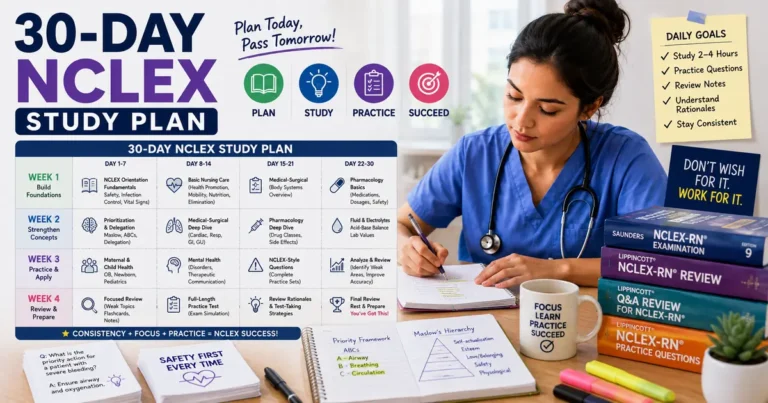
Pharmacology works best as a thread running through your entire study schedule rather than a single block you complete and move past. Pair each body system you review with its related medications — study cardiovascular disease processes alongside antihypertensives and antiarrhythmics, for instance, instead of studying them separately weeks apart.
If you’re still mapping out your overall timeline, a structured NCLEX preparation for nurses plan can help you sequence pharmacology alongside the rest of your content review instead of leaving it until the end. Candidates who want personalized feedback on where their pharmacology reasoning breaks down often benefit from working with NCLEX coaching for nurses to target those specific gaps.
NCLEX Pharmacology and the Next Generation NCLEX
Pharmacology hasn’t become less important under the Next Generation NCLEX — it’s become more embedded. Instead of standalone questions asking you to recall a single fact, medication content now frequently appears inside unfolding case studies, where a patient’s condition changes over several linked questions and a medication decision is just one part of a larger clinical picture.
This means a NGN pharmacology item might ask you to prioritize which of several medication-related actions to take first, or to evaluate whether a prescribed medication is even appropriate given the patient’s current labs and vital signs. Strong content knowledge alone won’t carry you through these formats — you also need to practice applying that knowledge inside a realistic, evolving scenario.
Final NCLEX Pharmacology Tips

Give yourself permission to prioritize. You will not memorize every medication that exists, and you don’t need to. Focus your energy on high-yield classes, understand the reasoning behind adverse effects and holding parameters, and practice applying that knowledge through realistic questions rather than flashcards alone.
Pharmacology rewards candidates who study patterns instead of isolated facts. Once that shift happens, medication questions start to feel far more manageable, even when the specific drug in front of you is one you’ve never directly reviewed.