
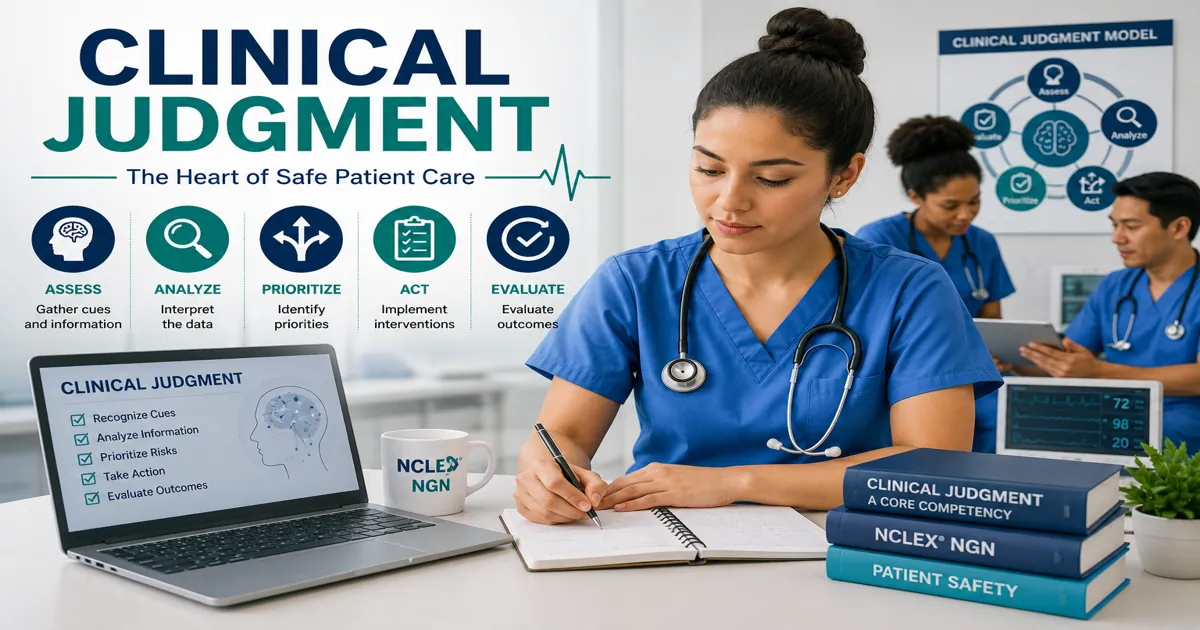
NCLEX Clinical Judgment Explained (2026): The Key to Passing the NCLEX

If there’s one skill that separates a confident pass from a stressful retake on today’s exam, it’s NCLEX clinical judgment. It’s no longer enough to memorize lab values or recall the “right” answer from a textbook — the exam wants to see how you think. In this guide, we’ll break down exactly what clinical judgment means on the NCLEX, how it’s measured, and the practical steps you can take to sharpen it before test day. If you’re still mapping out your overall approach, our NCLEX preparation hub is a good place to start alongside this article.
What Is NCLEX Clinical Judgment in Nursing?
Clinical judgment is the process nurses use to observe a patient’s situation, make sense of what’s happening, and decide on the safest, most effective action — then check whether that action actually worked. It’s the difference between knowing that a normal blood pressure sits within a certain range and recognizing that a patient’s blood pressure, in the context of their symptoms, history, and current medications, signals a developing problem.
Where memorization asks “what is the fact?”, clinical judgment asks “what does this fact mean for this patient, right now?” That shift — from recall to reasoning — is exactly what the modern exam is built to test, and it’s why so many candidates who did well on practice quizzes still find the real exam challenging.
Why Clinical Judgment Is Important on the NCLEX
Nursing regulators redesigned the exam because new nurses were entering practice with strong factual knowledge but inconsistent decision-making skills under pressure. According to NCSBN’s own research, this gap was identified through a multi-year practice analysis showing that newly licensed nurses are increasingly expected to make complex, safety-critical decisions early in their careers, which is part of why the Next Generation NCLEX was introduced.
On the exam, clinical judgment isn’t tested as a side topic — it’s woven through the case studies and stand-alone items that make up a meaningful share of your score. A candidate who can recite facts but struggles to prioritize or connect findings will find these sections difficult, no matter how much content they’ve memorized. This is also why our Next Generation NCLEX coverage and this article are meant to work together rather than repeat each other — one explains the exam format, this one builds the underlying skill.
The Clinical Judgment Measurement Model (CJMM)
The exam’s clinical judgment questions are built around a six-step framework developed by NCSBN, known as the Clinical Judgment Measurement Model. Rather than memorizing the names of the steps, it helps to understand what each one actually looks like in practice.

Recognize Cues — This is where you sift through the noise. A patient chart might include a dozen data points, but only a handful actually matter for the situation at hand. For example, a slightly elevated temperature might be irrelevant in one scenario and a red flag in another, depending on what else is going on with the patient.
Analyze Cues — Once you’ve spotted the relevant information, you connect it to what you know clinically. A rising heart rate paired with falling blood pressure and restlessness after surgery, for instance, points toward internal bleeding rather than simple anxiety.
Prioritize Hypotheses — With several possible explanations in front of you, you rank them by urgency and likelihood. The most life-threatening possibility that fits the evidence usually takes priority, even if it isn’t the most statistically common outcome.
Generate Solutions — Here you consider the range of appropriate nursing actions, weighing which ones are safe, evidence-based, and realistic given the situation.
Take Action — You choose and carry out the intervention that best matches the priority you identified — not just any reasonable action, but the one the situation actually calls for first.
Evaluate Outcomes — Finally, you check whether the action worked. Did the patient’s vital signs stabilize? Did the symptom resolve? This step is often the one candidates skip mentally, even though the exam tests it directly.
Working through practice scenarios with these six steps in mind — rather than trying to memorize their definitions — is one of the fastest ways to build genuine clinical judgment. Our NCLEX practice questions are organized to help you rehearse this exact process.
How Clinical Judgment Is Tested in the Next Generation NCLEX
The NGN measures clinical judgment through two main formats: standalone items and unfolding case studies. Standalone items include formats like bow-tie questions, where you connect a condition to its causes and actions in a single visual layout, and trend questions, where you interpret how a patient’s data changes over time.
Case studies go further. According to NCSBN, candidates can expect several scored case studies built around a single unfolding patient scenario, each followed by a set of related questions using formats such as matrix, cloze, drag-and-drop, and highlighting. These formats are specifically designed to make guessing harder and reasoning more visible, since many of them award partial credit based on how close your overall answer pattern is to the ideal one, rather than simple right-or-wrong scoring.
This is also why cramming facts alone rarely works for these sections. A candidate needs to practice reading a scenario, sitting with the ambiguity for a moment, and working through the CJMM steps rather than searching for a single memorized answer. For a deeper breakdown of how the exam itself is structured, see our full guide to the Next Generation NCLEX.
How to Improve Your Clinical Judgment

Clinical judgment isn’t something you either have or don’t — it’s a skill that improves with deliberate practice. A few approaches make a real difference:
Practice with realistic case studies, not just isolated questions. Working through a full unfolding scenario forces you to hold multiple pieces of information in mind at once, which mirrors what the exam — and real nursing practice — actually demands.
Narrate your reasoning out loud. Before selecting an answer, try explaining why it’s correct and why the other options are less appropriate. This habit exposes gaps in your reasoning that silent guessing hides.
Review rationales even when you get a question right. Getting the correct answer for the wrong reason is a common trap. Reading the rationale confirms whether your thought process actually matches the clinical logic the exam expects.
Reflect on real or simulated patient scenarios. If you’re in clinical rotations, take a few minutes after each shift to mentally walk through a case using the CJMM steps. This bridges the gap between classroom learning and exam-style reasoning.
If you’d like structured support building these habits, our NCLEX coaching for nurses program is built specifically around case-based reasoning practice rather than passive content review.
Common Mistakes That Affect Clinical Judgment
Even well-prepared candidates lose points due to a handful of recurring habits:
- Rushing through case studies. Unfolding scenarios reward patience. Skimming the stem to save time often means missing the one detail that changes the correct priority.
- Defaulting to the “textbook” answer instead of the safest one. The exam frequently presents several technically correct actions — the goal is to identify the one that addresses the most urgent risk to the patient first.
- Overlooking assessment findings that don’t fit the expected pattern. If a cue seems to contradict your initial impression, that’s usually the exam testing whether you’ll adjust your thinking or ignore inconvenient data.
- Relying on memorized templates. Templates work for straightforward recall questions, but clinical judgment items are designed to break formulaic thinking.
- Failing to reassess after taking action. Many candidates treat “take action” as the final step and skip evaluating whether the outcome actually improved.
Avoiding these patterns is often less about learning new content and more about slowing down and trusting the reasoning process.
Study Tips to Strengthen Clinical Judgment

- Use realistic, multi-step case studies rather than single best-answer questions exclusively, so you get comfortable holding several pieces of patient data in mind at once.
- Practice consistently in short, focused sessions rather than occasional long cram sessions — clinical reasoning is a habit, and habits build through repetition.
- Review every incorrect answer thoroughly, focusing on why your reasoning diverged from the correct clinical logic, not just which option was right.
- Time yourself on case studies occasionally to build comfort with the pacing of the real exam, since unfolding scenarios can feel longer than standalone questions.
- Revisit your weakest content areas through targeted practice, since shaky foundational knowledge makes it harder to reason clearly under pressure.
If you’re building a broader study plan around these habits, it’s worth reviewing your NCLEX registration timeline and eligibility requirements early, so your clinical judgment practice fits comfortably within your overall preparation window rather than being rushed at the end.
Final Thoughts
NCLEX Clinical judgment sits at the center of the modern NCLEX because it sits at the center of safe nursing practice. The good news is that it’s a trainable skill — every case study you work through, every rationale you review, and every scenario you reason out loud strengthens the exact muscle the exam is testing. Be patient with the process, practice consistently, and trust that this kind of deliberate reasoning practice pays off far beyond exam day.
For continued preparation, explore our NCLEX preparation resources, dive deeper into the Next Generation NCLEX format, work through our NCLEX practice questions, or get personalized guidance through our NCLEX coaching for nurses program.
Where can I find more NCLEX preparation resources?
You can explore our full NCLEX preparation hub, our NCLEX preparation for nurses pillar guide, and our how to pass the NCLEX article for a broader study roadmap.


[…] adaptive structure is also how the exam measures the reasoning skills we cover in our NCLEX Clinical Judgment guide — the case studies and standalone items you receive are selected using this same underlying […]
[…] options genuinely relate to addressing it? This is the same prioritization reasoning covered in our NCLEX clinical judgment guide, and it applies directly to SATA […]
[…] How Clinical Judgment Affects NCLEX Performance […]