
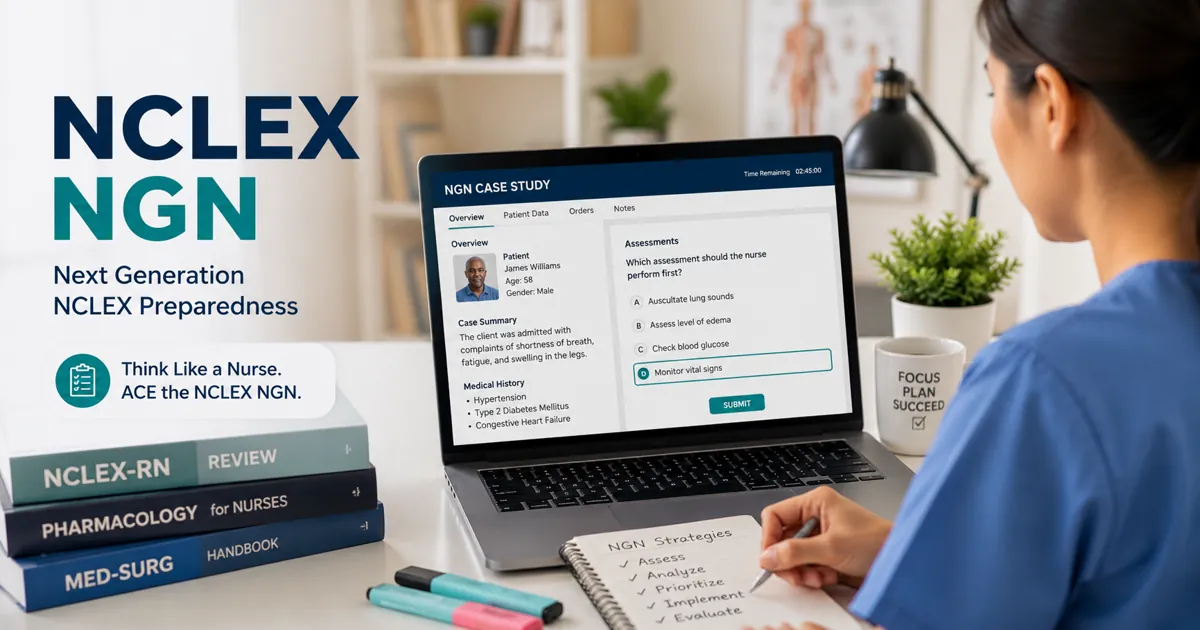
Next Generation NCLEX (NGN) Explained (2026): Complete Guide for Nurses
If you’re preparing for licensure this year, you’ve probably already heard the term “NGN” thrown around by classmates, instructors, or review course ads. The Next Generation NCLEX isn’t a separate test — it’s the current version of the NCLEX-RN and NCLEX-PN, and since 2023 it’s been the only version candidates sit for. Understanding how it works isn’t optional anymore; it’s the difference between studying the right way and wasting months on outdated methods.
This guide is written for nursing students, international nurses preparing through OET or IELTS pathways, and anyone who wants a clear, no-fluff explanation of what changed, why it changed, and how to actually prepare for it. By the end, you’ll understand the new question types, how scoring works, and what a realistic study plan looks like.
What Is the Next Generation NCLEX?

The Next Generation NCLEX is an updated version of the nursing licensure exam developed by the National Council of State Boards of Nursing (NCSBN). It launched in April 2023 and replaced the older exam format entirely — there’s no “old NCLEX” option anymore.
The core idea behind NGN is simple: multiple-choice recall questions weren’t doing a good enough job predicting whether a new nurse could actually think safely at the bedside. So NCSBN built a new set of question types designed to measure clinical judgment directly, rather than just testing whether you memorized the right fact.
If you’re just starting your prep, it helps to build your study plan around a structured NCLEX preparation approach rather than jumping straight into random question banks.
Why Was the NCLEX Updated?
NCSBN  didn’t make this change overnight. Years of research pointed to a troubling pattern: nurses were passing the traditional NCLEX but still struggling with real clinical decision-making once they started working — recognizing a deteriorating patient, prioritizing between competing tasks, or knowing when to escalate care.
Patient safety data backed this up. The gap between “can answer a multiple-choice question correctly” and “can make a safe decision under pressure” was wide enough that NCSBN decided the exam itself needed to change, not just the nursing curriculum around it.
The result is an exam built around a formal framework for judgment, not just knowledge.
How Is the NGN Different From the Previous NCLEX?

The biggest shift is philosophical before it’s technical. The old exam mostly asked, “Do you know this fact?” The NGN asks, “Can you use this fact to make a safe decision?”
Practically, that means:
- New question formats built around real patient scenarios, not isolated facts
- Case studies with unfolding or evolving patient conditions
- Partial-credit scoring on several question types, instead of strict right-or-wrong grading
- A heavier emphasis on prioritization, recognizing cues, and evaluating outcomes
The content categories (medical-surgical, pharmacology, mental health, and so on) haven’t disappeared. What’s changed is how that content gets tested.
Understanding Clinical Judgment
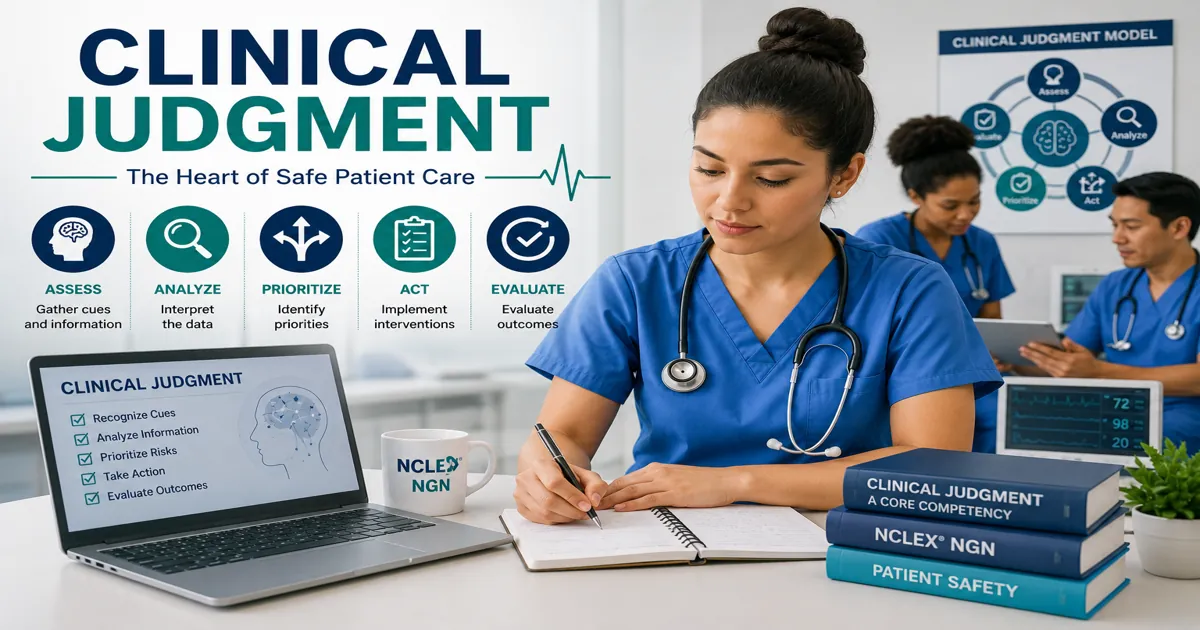
Clinical judgment is the thread that runs through every NGN question. NCSBN measures it using something called the Clinical Judgment Measurement Model (CJMM) — a six-step framework:
- Recognize cues
- Analyze cues
- Prioritize hypotheses
- Generate solutions
- Take action
- Evaluate outcomes
Every NGN item is mapped to one or more of these steps. Instead of memorizing thousands of isolated facts, you’re better off learning to walk through this cycle automatically — almost like a mental checklist you run for every patient scenario, whether it’s a case study question or a quick stand-alone item.
New Question Types in the Next Generation NCLEX

This is the part most candidates worry about, so let’s go through each format.
Case Studies. You’re given an unfolding patient scenario — admission notes, vitals, nurse’s notes — across several linked questions that build on each other as the patient’s condition changes.
Bow-Tie Questions. You work through a single scenario in three parts: the condition the patient likely has, the actions you should take, and the parameters you need to monitor. It visually looks like a bow-tie shape on screen.
Matrix/Grid Questions. You’re asked to evaluate several options against several criteria at once — useful for testing whether you understand a complex, multi-part clinical picture in one item.
Extended Multiple Response. A more advanced version of “select all that apply,” often with partial credit if you get some but not all of the correct selections.
Cloze (Drop-Down) Questions. Sentences within a clinical note or care plan that you complete by choosing the correct word or phrase from a drop-down list.
Traditional Question Types. Multiple choice, fill-in-the-blank, and hot-spot questions are all still part of the exam — NGN adds to the format, it doesn’t replace everything.
Working through realistic NCLEX practice questions in each of these formats before test day removes a lot of the surprise factor.
How the Next Generation NCLEX Is Scored
The NGN uses Computerized Adaptive Testing (CAT), just like the previous exam — the difficulty of each question adjusts based on how you’re performing. What’s new is the scoring model behind several of the item types.
Instead of a simple right-or-wrong system, many NGN questions use polytomous scoring, which allows for partial credit. Depending on the question type, this might work as:
- Straightforward right-or-wrong (“all-or-nothing”) scoring
- Plus/minus scoring, where wrong selections can subtract points
- 0/1 scoring for each individual part of a multi-part answer
This is exactly why guessing strategies from the old exam don’t transfer well. Selecting “everything that sounds reasonable” on an extended multiple response question can actually cost you points now.
How to Prepare for the NGN Successfully

A few things separate candidates who pass comfortably from those who struggle:
Study the CJMM, not just content. Once you understand the six-step judgment cycle, you can apply it to almost any scenario the exam throws at you, even topics you haven’t specifically reviewed.
Practice with real NGN-format questions. Old-style question banks won’t prepare you for bow-tie or matrix items. Make sure your resources reflect the current format.
Work on case studies under timed conditions. These take longer to read and process than traditional questions, so practicing your pacing matters.
Get structured support if you’re an international candidate. If English isn’t your first language, the reading load in unfolding case studies can be a real hurdle even when your clinical knowledge is solid. Working with a dedicated NCLEX coaching for nurses program can help close that gap faster than self-study alone.
Confirm your eligibility and paperwork early. Before you get deep into study mode, make sure your NCLEX eligibility requirements and NCLEX registration are sorted, so a scheduling delay doesn’t derail your study timeline.
Common Mistakes Nurses Make

Studying only for content, not judgment. You can know your pharmacology cold and still miss NGN questions if you haven’t practiced applying that knowledge inside a scenario.
Ignoring the newer question formats until the last minute. Bow-tie and matrix questions have a learning curve of their own, separate from the clinical content.
Underestimating reading time. Case studies come with a lot of text. Candidates who don’t practice reading efficiently often run short on time.
Treating extended multiple response like old “select all that apply.” Overselecting can now cost you points, so answer deliberately rather than defensively.
Skipping a realistic budget for the exam itself. Reviewing the current NCLEX exam fees ahead of time avoids last-minute financial surprises on top of exam stress.
Best Study Tips for Passing the Next Generation NCLEX
- Build a study schedule around the CJMM instead of a random list of topics
- Rotate between content review and NGN-format practice questions weekly
- Review the rationale behind both correct and incorrect answers, not just whether you got it right
- Take at least one full-length timed practice exam that includes case studies
- Revisit a solid NCLEX preparation for nurses guide periodically to make sure your plan still matches the current test blueprint
- Read through a how to pass the NCLEX strategy guide in your final few weeks to sharpen your test-day approach

The Next Generation NCLEX isn’t designed to trip you up — it’s designed to confirm that you can think like a nurse before you’re handed real patients. Once you understand the Clinical Judgment Measurement Model, the new question types stop feeling unfamiliar and start feeling like a natural extension of how you already think through patient care.
Give yourself time to practice each format, lean on structured coaching if you need it, and treat every practice question as a chance to rehearse the judgment cycle, not just recall a fact.
Your Questions Answered
1. Is the Next Generation NCLEX a completely different exam? No. It’s the current version of the same NCLEX-RN and NCLEX-PN exams, updated with new question formats designed to measure clinical judgment more directly.
2. When did the Next Generation NCLEX start? NGN launched in April 2023 and has been the only version of the NCLEX in use since then.
3. Is the NGN harder than the old NCLEX? It’s not necessarily harder, but it tests differently. Candidates who rely purely on memorization without practicing clinical reasoning often find it more challenging than expected.
4. What is the Clinical Judgment Measurement Model? It’s a six-step framework — recognize cues, analyze cues, prioritize hypotheses, generate solutions, take action, and evaluate outcomes — that NCSBN uses to structure and score NGN questions.
5. Does the NGN apply to both NCLEX-RN and NCLEX-PN? Yes. Both exams use NGN question types and the same clinical judgment framework, adjusted for the appropriate scope of practice at each level.
6. Can you get partial credit on the Next Generation NCLEX? Yes. Several NGN question types use polytomous scoring, which allows for partial credit rather than a strict right-or-wrong grade.
7. What are bow-tie questions on the NCLEX? Bow-tie questions ask you to identify a likely condition, appropriate actions, and parameters to monitor, all within a single scenario, visually laid out in a bow-tie shape.
8. How many questions are on the Next Generation NCLEX? Because the exam uses Computerized Adaptive Testing, the number of questions varies by candidate, generally including a set number of scored items plus a small number of unscored pretest items.
9. Do I need different study materials for the NGN? Yes, ideally. Older question banks built only around traditional multiple-choice won’t prepare you for case studies, bow-tie, or matrix items, so make sure your resources reflect the current format.
10. What’s the best way to start preparing for the NGN? Start by understanding the Clinical Judgment Measurement Model, then layer in content review and NGN-format practice questions together rather than studying content and format separately.
Ready to keep preparing?
If this guide helped clarify what the Next Generation NCLEX actually tests, the next step is putting it into practice. Explore our full NCLEX preparation resources, work through realistic NCLEX practice questions, or get one-on-one support through our NCLEX coaching for nurses program. And if you haven’t locked in your test date yet, our NCLEX registration guide walks you through the process step by step.

[…] How Clinical Judgment Is Tested in the Next Generation NCLEX […]
[…] reviewed how these newer formats work, it’s worth spending time with a dedicated Next Generation NCLEX resource before test day, since these items make up a meaningful part of how your overall ability […]